 CE
CEConstruction Electrician(CE Navy Rating)
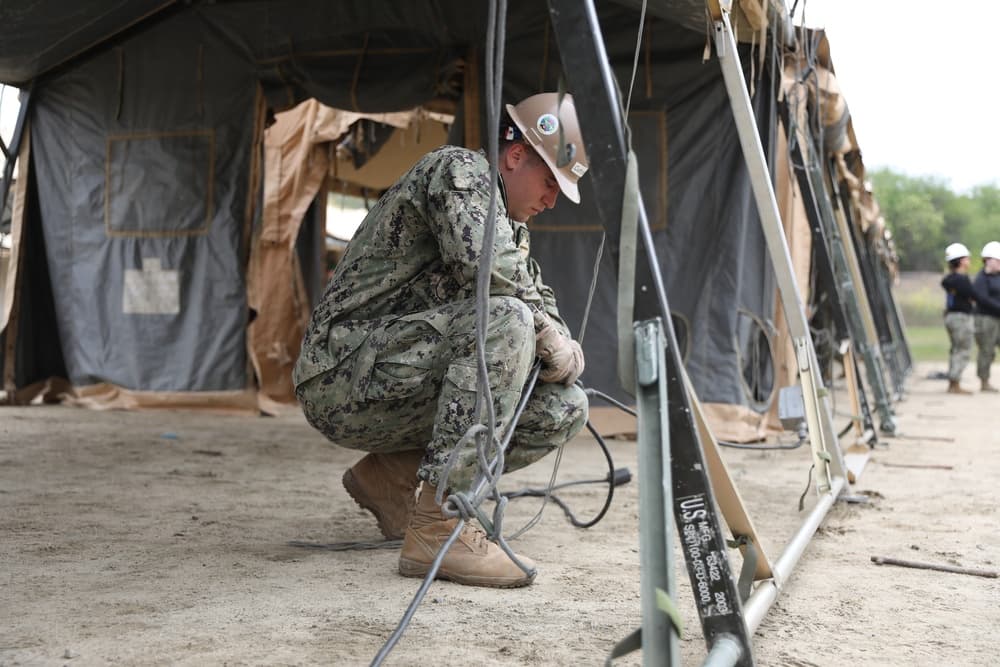
Installs and maintains electrical systems at Navy construction sites worldwide.
Underwater Construction Team (UCT) pathway. BU / CE / EO / UT / SW / CM / EA sailors can volunteer for the UCT NEC (5932), which combines Seabee construction skills with second-class diver qualification. See the ND profile for full UCT standards (age ≤ 27, dive PST, and the 16-week pipeline at NDSTC Panama City).
Overall
Quick Stats
- ✓Vision: Corrects to 20/20
- ✓Normal color perception
Security Clearance
Secret~$3K–$15K civilian sector value
Requires a National Agency Check with Local Agency Check and Credit Check (NACLC). Processing typically takes 1–3 months and is initiated early in your training pipeline.
ASVAB Requirements
AFQT Minimum
31
Line-score options — meet any one
- AR+MK+EI+GS≥201
Who This Is Best For
Best for aspiring electricians who want to earn licensure-track experience through real-world construction projects around the globe. Training hours translate directly to civilian apprenticeships and journeyman credentials — one of the most directly transferable Seabee rates.
+Pros
- ✓Strong civilian career transition
–Cons
Real Opinions
+Positive
“Seabees are the best-kept secret in the Navy. Great deployments, real skills, and you actually build stuff.”
“CE is one of the best-kept secrets in the Navy. You learn real electrical work and get licensed. Civilian electricians make great money.”
–Negative & Mixed
“Deployments can be to some rough locations. And you are still in the Navy, so expect Navy nonsense on top of the construction work.”
“Advancement can be slow in the construction rates because the community is smaller than fleet rates.”
Page 1 of 3
Share your opinion about CE
0 charsRecruiter vs Reality
What the recruiter says vs. what it's actually like.
🫡 Recruiter says
“Seabees travel the world building things and have great quality of life!”
💀 Reality
Source: MyNavyRates researchQuality of life is generally good but deployments to austere locations (desert, jungle) are common. You will do real construction but also a lot of maintenance and military duties.
🫡 Recruiter says
“CE leads to a journeyman electrician career.”
💀 Reality
Source: sailor forumsCE experience counts toward civilian apprenticeship hours in many states. Combined with the GI Bill for trade school, CE is one of the strongest blue-collar career pipelines in the Navy.
Page 1 of 7
Horror Stories
Real stories people have shared about this rate. Swipe to browse.
“CE sailors on summer deployment to Bagram saw tent temperatures exceeding 120 degrees, extremely poor air quality, and burn pits blowing toxic smoke directly into living areas. PT was nearly impossible.”
Story 1 of 4
Share a horror story about CE
0 charsRelated Reading
Guides on picking a rate, ASVAB, bonuses, promotion, and life after the Navy.
Getting Started
How do you choose the right Navy rate for you?
Choosing a Navy rate means weighing your ASVAB scores, lifestyle preferences, civilian career goals, and willingness to deploy or go to sea. Start by identifying which ratings you qualify for, then narrow the list by what matters most to you.
Getting Started
What is the ASVAB and what scores do you need?
The ASVAB is a multi-aptitude test that determines which Navy ratings you qualify for. Your sub-test scores combine into line scores, and each rating has minimum line-score requirements. Higher scores open more options.
Career & Pay
Which Navy rates have the biggest enlistment bonuses in 2026?
Active Component (Active Duty) only. Per the CNRC GENADMIN dated 24 July 2026, the biggest source-rate bonus is $40,000 — Nuclear Field on FY26 ship dates ($75,000 EB cap). Special Warfare Boat Operator (SB) follows at $35,000, then EOD and SEAL (SO) at $30,000, and Aviation Rescue Swimmer (AIRR) and Cryptologic Technician Maintenance (CTM) at $25,000. Special Operations Future Sailors who clear the elevated PST standards add a flat $20,000 EBPST. Most rates cap at $50,000 total EB. The Loan Repayment Program adds up to $65,000 on top, separately. Reserve component (SELRES) bonuses are governed by a different message and are not covered here.