myNavyRates.rg
Home/Compare All Rates/ND
Donate
Compare All RatesBest ListsQuizPayBonusesASVAB CalculatorAdvancement Name SearchDuty StationsFamily ImpactFree DegreeRecruitersBe an OfficerArticlesFAQs
myNavyRates.rg
Donate

Explore

  • All Rates
  • Side-by-Side
  • Best Lists
  • Articles
  • FAQs

Tools

  • Take the Quiz
  • Anti-Match Quiz
  • ASVAB Calculator
  • Pay
  • Pay Value
  • Bonuses
  • Advancement

Life in the Navy

  • Duty Stations
  • Family Impact
  • Free Degree
  • Be an Officer
  • Recruiters

About

  • About
  • Contact
  • Changelog
  • Donate
  • Privacy
  • Disclaimer
  • Sitemap

Not affiliated with the U.S. Navy or Department of Defense.·© 2026 myNavyRates.org. All rights reserved.

HomeCompare RatesQuizBonusesASVAB CalculatorMore
Home/Rates/ND
Navy Diver sailor
Navy Diver rating badgeND

Navy Diver(ND Navy Rating)

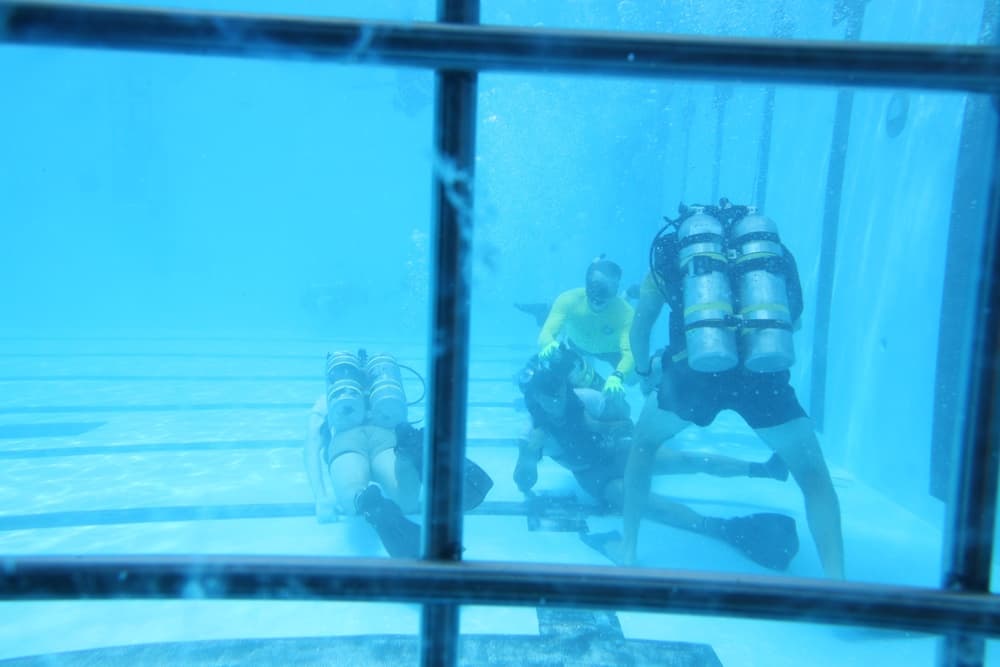
Navy Divers perform underwater ship maintenance, salvage, construction, and explosive ordnance disposal support. They operate in some of the most challenging environments in the military.

ATFAdvanced Technical Field

Overall

6.4/10
Burnout4.6
Lifestyle5.5
Civilian ROI8.5
Happiness7.5
Manning %5.8
$$$ Pay6.5

Quick Stats

Enlistment Bonus$20,000
Civilian Sector Transferability$60k–$120k
Advancement OutlookStrong opportunity
Manning %91%
Initial Contract3 yr active /
Medical Requirements
  • ✓Vision: Uncorrected ≤ 20/200 each eye, corrects to 20/25; lack of color vision disqualifying; no waivers
  • ✓Normal color perception

Security Clearance

Secret~$3K–$15K civilian sector value

Requires a National Agency Check with Local Agency Check and Credit Check (NACLC). Processing typically takes 1–3 months and is initiated early in your training pipeline.

ASVAB Requirements

Line-score options — meet any one

Who This Is Best For

Best for physically elite individuals who are completely comfortable in the water and want adventure combined with highly specialized skills. Special duty pay, unique deployments, and a direct path to commercial diving careers paying $80K–$150K+ make this exceptionally rewarding. The physical standards are demanding and non-negotiable — if you can meet them, few rates offer this combination of challenge, pay, and post-Navy value.

+Pros

  • ✓Active enlistment bonus available
  • ✓Strong opportunity advancement outlook
  • ✓Strong civilian career transition

–Cons

    Real Opinions

    +Positive

    ✓

    “Not gonna lie, the pipeline is the hardest thing I have ever done. But the community is tight and the job is incredible.”

    r/navy|
    ✓

    “Best job in the Navy bar none. You get paid to dive, the community is tight, and the work is exciting every single day.”

    Indeed|

    –Negative & Mixed

    ✗

    “Attrition rate is insane. Most people who start the pipeline do not finish. Have a backup plan.”

    r/newtothenavy|
    ⚬

    “The pipeline is no joke. Dive school has a high attrition rate and the physical standards never stop.”

    Reddit|

    Page 1 of 3

    Share your opinion about ND

    0 chars
    Select one:

    Recruiter vs Reality

    What the recruiter says vs. what it's actually like.

    🫡 Recruiter says

    “This is the most elite program in the military. You will be among the best of the best!”

    💀 Reality

    Source: MyNavyRates research

    The attrition rate is 50-80%. Most candidates do not complete the pipeline and get reassigned to fleet needs. Physical and mental demands are extreme and ongoing.

    🫡 Recruiter says

    “Navy Divers have the coolest job in the military”

    💀 Reality

    Source: Glassdoor

    The training is brutal, the water is cold, and the work is physically punishing on your body long-term. Joint problems, ear issues, and back injuries are common. The job is incredible but your body pays the price. Make sure you understand the long-term physical cost, not just the adventure.

    Page 1 of 6

    😱

    Horror Stories

    Real stories people have shared about this rate. Swipe to browse.

    💀

    “MK 16 rebreather dive, Little Creek, 170 feet. Training evolution, simulated hull inspection. My dive buddy's rig went into overpressure and we both went to bailout. Ascent protocol is six feet per minute with mandatory stops — slower than a gentle elevator. My buddy panicked. He kicked for the surface. I held his BCD strap to slow him. We came up too fast. I surfaced, tasted copper on my tongue, and took one step onto the dive platform before my right leg stopped working. Joint pain hit my shoulders ten seconds later — like somebody had driven an icepick into the socket and twisted. The recompression chamber was a six-hour ride. I was lucky. My buddy stroked out on the platform — arterial gas embolism — and was DOA before the comms reached the ambulance. Naval Safety Command's diving mishap database logs twenty to thirty Type I/II DCS cases a year in the community. Every ND I know has either taken a ride in the chamber or watched someone who did not come out.”

    Source: navalsafetycommand.navy.mil|

    Story 1 of 5

    Share a horror story about ND

    0 chars

    Related Reading

    Guides on picking a rate, ASVAB, bonuses, promotion, and life after the Navy.

    Getting Started

    How do you choose the right Navy rate for you?

    Choosing a Navy rate means weighing your ASVAB scores, lifestyle preferences, civilian career goals, and willingness to deploy or go to sea. Start by identifying which ratings you qualify for, then narrow the list by what matters most to you.

    Getting Started

    What is the ASVAB and what scores do you need?

    The ASVAB is a multi-aptitude test that determines which Navy ratings you qualify for. Your sub-test scores combine into line scores, and each rating has minimum line-score requirements. Higher scores open more options.

    Career & Pay

    Which Navy rates have the biggest enlistment bonuses in 2026?

    Active Component (Active Duty) only. Per the CNRC GENADMIN dated 24 July 2026, the biggest source-rate bonus is $40,000 — Nuclear Field on FY26 ship dates ($75,000 EB cap). Special Warfare Boat Operator (SB) follows at $35,000, then EOD and SEAL (SO) at $30,000, and Aviation Rescue Swimmer (AIRR) and Cryptologic Technician Maintenance (CTM) at $25,000. Special Operations Future Sailors who clear the elevated PST standards add a flat $20,000 EBPST. Most rates cap at $50,000 total EB. The Loan Repayment Program adds up to $65,000 on top, separately. Reserve component (SELRES) bonuses are governed by a different message and are not covered here.

    Real Opinions

    +Positive

    ✓

    “Not gonna lie, the pipeline is the hardest thing I have ever done. But the community is tight and the job is incredible.”

    r/navy|
    ✓

    “Best job in the Navy bar none. You get paid to dive, the community is tight, and the work is exciting every single day.”

    Indeed|

    –Negative & Mixed

    ✗

    “Attrition rate is insane. Most people who start the pipeline do not finish. Have a backup plan.”

    r/newtothenavy|
    ⚬

    “The pipeline is no joke. Dive school has a high attrition rate and the physical standards never stop.”

    Reddit|

    Page 1 of 3

    Share your opinion about ND

    0 chars
    Select one:

    Recruiter vs Reality

    What the recruiter says vs. what it's actually like.

    🫡 Recruiter says

    “This is the most elite program in the military. You will be among the best of the best!”

    💀 Reality

    Source: MyNavyRates research

    The attrition rate is 50-80%. Most candidates do not complete the pipeline and get reassigned to fleet needs. Physical and mental demands are extreme and ongoing.

    🫡 Recruiter says

    “Navy Divers have the coolest job in the military”

    💀 Reality

    Source: Glassdoor

    The training is brutal, the water is cold, and the work is physically punishing on your body long-term. Joint problems, ear issues, and back injuries are common. The job is incredible but your body pays the price. Make sure you understand the long-term physical cost, not just the adventure.

    Page 1 of 6

    😱

    Horror Stories

    Real stories people have shared about this rate. Swipe to browse.

    💀

    “MK 16 rebreather dive, Little Creek, 170 feet. Training evolution, simulated hull inspection. My dive buddy's rig went into overpressure and we both went to bailout. Ascent protocol is six feet per minute with mandatory stops — slower than a gentle elevator. My buddy panicked. He kicked for the surface. I held his BCD strap to slow him. We came up too fast. I surfaced, tasted copper on my tongue, and took one step onto the dive platform before my right leg stopped working. Joint pain hit my shoulders ten seconds later — like somebody had driven an icepick into the socket and twisted. The recompression chamber was a six-hour ride. I was lucky. My buddy stroked out on the platform — arterial gas embolism — and was DOA before the comms reached the ambulance. Naval Safety Command's diving mishap database logs twenty to thirty Type I/II DCS cases a year in the community. Every ND I know has either taken a ride in the chamber or watched someone who did not come out.”

    Source: navalsafetycommand.navy.mil|

    Story 1 of 5

    Share a horror story about ND

    0 chars
  • VE+AR≥105 and MC≥51
  • AR+2MK+GS≥210 and MC≥51
  • GS+MC+EI≥157 and AR+MK≥100
  • Calculate your score →

    Medical Requirements — detail

    Uncorrected vision can be no worse than 20/200 in each eye. Both eyes must correct to 20/25. Lack of adequate color vision is disqualifying. No color deficiency waivers authorized.

    Remarks

    Must meet physical requirements per reference (e) and pass the physical screening test IAW reference (b). See MILPERSMAN 1220-410 and 1220-100. Must be 30 years of age or less at time of accession. Special Requirements for Warrior Challenge: Candidates for the Warrior Challenge Program with following conditions are disqualified and no waiver will be approved: 1. Lack of normal color perception. No color vision waivers will be approved for any program; 2. Any broken bone or joint from which applicant was cleared within the last 6 months (Must be 6 months since the date cleared from treatment); 3. Any surgery from which cleared within last 6 months (must be 6 months since date cleared from treatment); 4. Stress fractures occurring within the last 6 months; 5. More than a single kidney stone; 6. Seizures (other than childhood seizures); 7. Concussions that resulted in a coma or have persistent neurologic deficits; 8. Any drug use except for marijuana (CNRC Warrior Challenge Program Manager may conduct a program eligibility determination for ONE misdemeanor drug abuse conviction marijuana ONLY OR a possession of drug paraphernalia (marijuana ONLY). Determinations will be made strictly on a case-by-case basis.) 9. Any daily Asthma medications after the age of 13; 10. Anaphylaxis (all allergies should be documented as to what the reaction is); 11. Angioedema; 12. Inability to perform Valsalva maneuver (Chronic Eustachian tube dysfunction); 13. Ulcers; 14. Pneumothorax (spontaneous); 15. Pulmonary Blebs; 16. Emphysema; 17. COPD; 18. Central blood clots (strokes, pulmonary emboli); 19. Suicidal ideations; 20. ADHD (No medications or symptoms in the last 12 months prior to accession); 21. Any history of mental health issues/disorders.

    Source: CNRC / ECM Rating List, 19 Jan 2026. Verify current guidance with your recruiter before signing.

    Training Pipeline — Total ~23 weeks (5 months)

    8w
    15w
    Boot Camp— 8 weeks
    RTC Great Lakes, IL
    Basic military training for all recruits
    A-School— 15 weeks
    Panama City, FL
    60% washoutDifficulty: 5.4/10
    Technical training for rating qualification
    Fleet Assignment— 0 weeks
    First duty station
    Report to operational command

    Calculate Your End Training Date and Holidays and Events You Will Miss During Training

    Ship dates are approximate and based on the weekly RTC Great Lakes schedule. Confirm your exact date with your recruiter. Source: bootcamp.navy.mil

    Career Progression Milestones

    Estimated timeline based on current advancement rates. Actual timing varies by individual performance and Navy needs.

    5 mo
    1 mo
    1yr 5mo
    6 mo
    1yr 6mo
    Training Complete— 5 mo
    Pipeline finished (~5 mo) — Panama City, FL
    First Duty Station— 6 mo
    Sea or shore duty assignment
    NEC Specialization Options— 1yr 11mo
    11 specializations available
    MMDVM1DVM2DV

    Advancement Outlook

    E-2 to E-4 Advancement Outlook

    Time to E-4: 30 months total

    • E-1 → E-2: 9 months at E-1. Automatic
    • E-2 → E-3: 9 months at E-2. Automatic
    • E-3 → E-4: 12 months at E-3. Automatic

    E-4 is automatic — competitive advancement starts at E-5

    How to advance faster to E-4

    Your recruiter can process you in at E-2 or E-3 on day one if you qualify. Every rung skipped shortens the path to E-4 by months. Official transcripts / certificates required at enlistment.

    • E-2 →Easy
      2 years of JROTC completed. Easiest common path if your high school offers JROTC.
    • E-2 →Moderate
      24+ semester hours/ 36+ quarter hours of college credit (below the associate's threshold). Roughly one full year of college.
    • E-2 →Moderate
      Civil Air Patrol Billy Mitchell Award. Achievable with consistent cadet participation, but requires testing and leadership time.
    • E-2 →Moderate
      Sea Cadet Corps — reaching the Sea Cadet E-2 rate (join by age 17).
    • E-2 to E-3 →Moderate
      Boot camp leadership roles — roles don't auto-pin rank. Advancement comes from earning Honor Recruit or Hall of Fame at graduation (one award only, not stacked).
      • Honor Recruit up to E-2 — effectively the #1 ranked recruit in your division (~60-80 recruits), one Sailor per division per cycle. Selection is based on cumulative performance across all three academic exams, Physical Readiness Test (PRT) scores, uniform and personnel inspections, military bearing, and peer/Recruit Division Commander (RDC) evaluations. Roles that typically compete at this level:
        • Assistant LPO (ALPO) — deputy to the LPO.
        • Master-at-Arms (MAA) — barracks cleanliness, standards, and discipline.
        • Yeoman (YN) — division admin, paperwork, and tracking.
        • Educational Petty Officer (EPO) — study groups, test prep, and academic remediation.
        • Religious Petty Officer (RPO) — coordinates chapel and religious services.
        • Athletic Petty Officer (APO) — leads PT and fitness assessments.
        • Mail Petty Officer — handles mail distribution and tracking.
        • Section Leaders — squad-level leaders below the division-wide roles.
      • Hall of Fame up to E-3 — the most elite recognition at Recruit Training Command (RTC), awarded Navy-wide rather than per division. Requires exceptional performance in every training metric: top-tier scores on all three academic exams (typically 90%+), "Outstanding" on the final Physical Readiness Test (PRT), near-perfect uniform and personnel inspections, held a division leadership role with strong performance, and zero remediation, infractions, or negative marks across the full training cycle. Senior leadership roles positioned to compete:
    • E-3 →Moderate
      3 years of JROTC completed (any service branch). Straightforward if your high school has the program — three school years of enrollment.
    • E-3 →Hard
      Eagle Scout (BSA) or Gold Award (GSUSA) — the highest youth scouting awards. Typically takes years of participation and a capstone service project.
    • E-3 →Hard
      Associate's degree (or 48+ semester hours / 72+ quarter hours of college credit, 100-level or higher from an accredited institution). Two years of full-time college.
    • E-3 →Hard
      Civil Air Patrol Earhart Award. Uncommon — only a small fraction of CAP cadets reach this level.
    • E-3 →Hard
      Sea Cadet Corps — reaching the Sea Cadet E-3 rate (join by age 16).

    Ceiling is E-3 at accession — stacking qualifications doesn't push you to E-4 out of the gate.

    Ways to accelerate E-4 after you're in

    • HardAdvanced Technical Field (ATF) ProgramAuto E-4 — ND is on the ATF roster. Per MILPERSMAN 1510-030 §3a the full ATF list is the Naval Aircrewman service ratings (AWF / AWR / AWS / AWO / AWV), the cryptologic / cyber ratings CTI, CWT, the special-operations ratings EOD, ND, SB, SO, plus IC, IS, IT, the submarine-IT ratings ITE / ITN / ITR, and specific HM advanced NECs (L00A, L02A, L08A, L17A, L24A, L27A, L31A). ATF Sailors advance to E-2 on RTC graduation (§2b), E-3 after 9 months TIG (§9c), and E-4 after A-school + required advanced training + 6 months TIG at E-3 (§9d). Governed by MILPERSMAN 1510-030 (CH-94, 16 Mar 2026) and MILPERSMAN 1430-010. Requirements (§9d):
      • All requirements for advancement in rate completed
      • CO recommendation via NAVPERS 1336/3
      • PFA / body-composition standards (OPNAVINST 6110.1K)
      • Required advanced training complete
      • Sufficient obligated service — ATF carries a 6-year OBLISERV (§7)
      ATF is an enlistment-level election at MEPS / RTC (§2a). Fleet Sailors may request enrollment while at a training activity; conversion into an ATF-only rating auto-enrolls. Advanced training for ND is included in the A-school pipeline itself (§4b.1.c), so the 6-months-TIG-at-E-3 clock starts at A-school completion.
    • Very Hard — Command-nominated promotion that skips the exam entirely. Each command gets a small seasonal quota of MAP slots and hands them to the top performers based on evaluation ranking. Fastest path on paper, but you're competing directly with every other sailor at your command.

    Rules can change — verify current criteria with your recruiter and in the latest Navy Recruiting Manual (COMNAVCRUITCOM) before signing any paperwork that assumes a specific entry paygrade.

    E-5 and E-6 Advancement Outlook

    Strong opportunity★★★☆

    2 of 4 factors working in your favor · 1 working against you

    • ▼

      Manning

      E5 74%E6 107%
      E5 is undermanned while E6 is overmanned. Your advancement outlook depends on which paygrade you're promoting into next.

      Source: N12 Community Health Indicator brief (FY26)

    • ▲

      Initial Enlistment Bonus

      Yes — active bonus

      The Navy currently pays an enlistment bonus to new recruits who select this rate. An active bonus usually signals the community is short on accessions, which is the same pressure that keeps senior billets open.
    • ▲

      Overall Selective Reenlistment Bonus (SRB) Outlook

      Navy is paying a substantial bonus to retain sailors. Strong signal that billets are staying empty at senior paygrades.

    Bonuses — Click here to see your military pay

    All Active CNRC Enlistment Incentives

    Active Duty

    Source: CNRC GENADMIN 24 JUL 26 — effective Jul 27, 2026, contracts authorized through Dec 31, 2026 (NDAA 2026)

    Active Component only. Reservist (SELRES) shipping bonuses are set by a separate CNRF incentive message — ask your recruiter.

    Bonuses can stack up to the rating's EB cap; LRP is independent. Footnote numbers match the source GENADMIN.

    Source-Rate Bonus (EBSR)

    Earned at school graduation; only EB type that can be partially recouped.

    ND-ATF

    Any

    $20,000[5, 6]

    Physical Screening Test Bonus (EBPST)

    NSO ratings only — for FSs who exceed elevated PST standards.

    ND-ATF

    October–September Any

    $20,000[1, 2]

    EBSR Notes

    • 5EOD ATF: payment after EOD "A" school. Navy Diver (ND) ATF: payment after Dive "A" school. Special Warfare Operator (SO) ATF: payment after SEAL Qualification Training (SQT).
    • 6Sailor must have earned the rating Navy Enlisted Classification (NEC) and a security clearance.

    EBPST Notes

    • 1EBPST eligibility exists only while the FS is in DEP. May not reclassify at RTC. Earned and payable upon RTC graduation. Cannot be recouped for post-RTC reclassification or separation.
    • 2When a Future Sailor meets the elevated PST standards in COMNAVCRUITCOMINST 1121.2D (Navy Special Operations program guidance), the EBPST is added to the Enlistment Guarantee (NAVCRUIT 1133/52).

    Cross-cutting Policy Notes

    • 1Future Sailors with Tier 3 education credentials (e.g., HiSET / GED / alternative credential) are NOT authorized any EB.
    • 2Prior-service members re-enlisting onto Active Duty must enter at pay grade E-4 or below, must not have received a bonus on their first enlistment, and (Navy prior-service) must have been separated from active duty for at least 12 months before shipping.
    • 3EBHS (EB for High School) is currently NOT AUTHORIZED in this message — distinct from prior cycles when EBHS was offered.
    • 4During lapsed appropriations, classifiers may still include EB on a contract if the DD 1966 carries the funding-availability disclaimer; payment is then subject to a future appropriation.
    • 5Bonuses are paid in installments. Only the unearned portion of EBSR is eligible for recoupment; EBSHP/EBPST cannot be recouped due to post-RTC reclassification or separation.

    Always verify with a recruiter before signing — eligibility depends on AFQT, education tier, security-clearance adjudication, ship date, and program availability. Funding subject to congressional reauthorization of 37 USC § 331.

    How to qualify & get paid

    1. Sign a contract for this rate at MEPS with the bonus(es) listed on your NAVCRUIT 1133/52 Enlistment Guarantee — eligibility is locked at signing.
    2. Ship to Recruit Training Command (RTC) Great Lakes inside the authorized window — EBSHP and EBPST are earned and paid at RTC graduation and cannot be recouped after.
    3. Complete A-school (and any required follow-on C-school or qualifying course) for your rating — EBSR is earned and paid at school graduation, except for the Special-Operations pipelines, which pay later (AIRR after FRS + first duty station; SO after SQT; SB after SWCC Charlie phase; EOD/ND after their respective A-schools).
    4. LRP is paid annually upon submission of a DD 2475; ~25% is withheld for federal taxes, and a W-2 is issued. LRP must be on your contract at accession — it cannot be added later via reclassification.

    Important details & disqualifiers

    • •All bonuses on this page are Active Component (Active Duty) only. Reservists (SELRES) follow a separate CNRF incentive message — ask your recruiter.
    • •Future Sailors with Tier 3 education credentials (HiSET / GED / alternative) are NOT authorized any EB.
    • •AFQT score must be ≥ 31 for EBSHP and ≥ 50 for LRP.
    • •EBSR is the only EB type that can be partially recouped if you separate before completing the obligated service. EBSHP / EBPST cannot be recouped after RTC.
    • •Bonus payments are subject to federal income tax withholding.
    • •EB-for-High-School (EBHS) is currently NOT authorized in the July 2026 GENADMIN — distinct from earlier cycles when it was offered.
    • •Funding: NDAA 2026 authorizes contracts through 31 December 2026; appropriations cover obligations through 30 September 2026; max-EB authority extends through 10 January 2027 — all subject to congressional reauthorization of 37 USC § 331.
    • •This rate requires a security clearance — failure to obtain clearance may affect bonus eligibility (and several special-operations footnotes explicitly require an earned NEC + clearance before payment).

    Historical Bonus Trend by Contract Length

    Past NAVADMIN cycles, broken out by contract years. The current CNRC GENADMIN's source-rate bonus (EBSR) is a single amount per rate and appears above; the four-line chart below shows the older multi-contract structure for trend context only.

    You May Qualify for a Navy Enlisted Classification (NEC)

    Specialties within this rate you can select, some with additional compensation. Each NEC has its own training, bonus potential, and career path.

    MMDVMaster Diver

    Qualified to direct and supervise diving, salvage, ship repair operations and diving programs. Directly responsible to the Commanding Officer for all facets of command diving operations and programs, to include training, equipment, systems, personnel, operations. Develops, updates and oversees diving programs.

    Requirements

    • Minimum 6 years' experience in NEC code M1DV.
    • Minimum 2 years from date of frocking to E7.

    Selective Reenlistment Bonus (SRB)

    —

    First Reenlistment (17 mo to 6 yrs Active Duty)

    Not eligible

    —

    Second Reenlistment (6 to 10 yrs Active Duty)

    Not eligible

    🟡

    Third Reenlistment (10 to 14 yrs Active Duty)

    $100,000

    Max

    Reduced · effective 2025-12-18

    Potential Civilian Post-Navy Outcomes

    Commercial Diver

    Transferability: 8.5/10

    $60k–$120k

    Underwater Welder

    Transferability: 9/10

    $75k–$150k

    Post-Navy Salary Trajectory

    Estimated civilian salary growth after separating from the Navy, based on industry data for this rating's skill set.

    Year 1

    $60K

    Year 5

    $82K

    Year 10

    $110K

    10-year growth: +83%

    Retention & Burnout

    First-Term Retention

    60%

    choose to reenlist

    Burnout Index

    4.6/10

    Moderate

    Watch Intensity

    5

    Hours/Day

    9

    Deploy Tempo

    7

    Manning Strain

    2

    Low Morale Risk

    3

    Attrition Signal

    4

    What this means: The Burnout Index combines watch intensity (25%), daily hours (20%), deployment tempo (15%), manning strain (15%), morale (15%), and attrition (10%) into a single risk score.

    Lifestyle6/10

    Ship vs. Shore Split

    50% / 50%

    Sea Duty Tempo

    High — 7/10

    Physical Demand

    high — outdoor

    Sea Duty Tempo measures how much of a career is spent in deployable billets — ships, submarines, deploying squadrons, and expeditionary units — and how often those units leave homeport. It is separate from physical demand: an administrative job aboard a deployed unit still deploys, and a hands-on maintenance job at a shore command does not.

    Watch Standing

    Mission-dependent rotation, no fixed schedule

    Watch standing is a 24-hour duty rotation where sailors take turns manning critical positions aboard the ship or at their command. The rotation determines how frequently you stand watch and how much rest time you get between shifts.

    Operational tempo drives schedule. Extended field exercises and real-world missions are common.

    OPNAVINST 3120.32DUSNI ProceedingsNavy Watch Standing Manual

    Life on Watch — Sea Stories

    “I was on standby diver watch when we got tasked with an emergency hull inspection on a submarine that had struck an uncharted object. I went down in zero-visibility water at night, running my hands along the hull feeling for damage while my dive buddy tended the line. Found a 3-foot gash in the sonar dome fairing. The sub couldn't deploy until we patched it. We worked underwater for six hours in shifts, applying an emergency cofferdam patch. The sub made its deployment window by 4 hours. Most people picture Navy Divers in crystal-clear tropical water. The reality is pitch-black harbors at 0200 feeling for damage with your fingertips.”

    Veteran account / ScubaBoard

    Story 1 of 4

    Common Duty Stations

    Naval Station NorfolkSea
    Family Friendly

    6.9/10

    Schools + spouse jobs

    Base Housing Wait

    10 months

    Avg waitlist for on-base

    Cost of Living

    95

    100 = national avg

    Naval Base San DiegoSea
    Family Friendly

    7.9/10

    Schools + spouse jobs

    Base Housing Wait

    14 months

    Avg waitlist for on-base

    Cost of Living

    135

    100 = national avg

    Naval Station JacksonvilleShore
    🎓

    Step-by-Step Strategy Guide to Getting an Associate's Degree After Boot Camp — For Free

    Most sailors don't know they already have 9 or more general education college credits just from graduating boot camp.

    Based on your rate, you may have more.

    You can earn an associate's degree for free in 12-30 months without spending a dime.

    Strategy Guide & Boot Camp College Credit Calculator →
    Not the rate for you? See other ratings side by side →

    Talk to a Sailor

    Community Poll

    If you could go back, would you pick ND again?

    Career & Pay

    How does promotion work in the Navy?

    Navy advancement depends on exam scores, evaluations, time in rate, and available quotas. Some ratings promote over 50% of eligible sailors while others promote less than 5%. Your rate choice directly affects how fast you can advance.

    Career & Pay

    Which Navy jobs set you up best for a civilian career?

    Information warfare ratings (IT, CTN, IS) and medical ratings (HM) offer the strongest civilian career pipelines. Security clearances, technical certifications, and hands-on experience make these sailors highly competitive in the private sector.

    Browse all articles →

    Life on Watch — Sea Stories

    “I was on standby diver watch when we got tasked with an emergency hull inspection on a submarine that had struck an uncharted object. I went down in zero-visibility water at night, running my hands along the hull feeling for damage while my dive buddy tended the line. Found a 3-foot gash in the sonar dome fairing. The sub couldn't deploy until we patched it. We worked underwater for six hours in shifts, applying an emergency cofferdam patch. The sub made its deployment window by 4 hours. Most people picture Navy Divers in crystal-clear tropical water. The reality is pitch-black harbors at 0200 feeling for damage with your fingertips.”

    Veteran account / ScubaBoard

    Story 1 of 4

    717B
    + more
    C-School / Advanced Training— 2yr 5mo
    1 follow-on school available
    Shore Duty Rotation— 3yr 11mo
    First shore rotation opportunity
    • Leading Petty Officer (LPO) — runs day-to-day ops inside the division.
    • Assistant RCPO (ARCPO) — backs up the RCPO and steps in when needed.
    • Recruit Chief Petty Officer (RCPO) — senior recruit in the division, overall accountability to the RDCs. Highest visibility for meritorious advancement.
    Meritorious Advancement Program (MAP)
    Competitive
    +0 SRB added/increased · −1 SRB reduced/eliminated
    $100,000 max
  • ●

    Billet-Based Advancement eligibility

    Legacy exam cycles

    This rating has not been integrated into Billet-Based Advancement yet. Advancement still runs through the traditional exam and Final Multiple Score (FMS) system — your exam score is one of the main factors in how you promote.
  • Sources: Manning NAVADMIN · SRB NAVADMIN · Billet-Based Advancement Handbook (NAVADMIN 255/24, updated via NAVADMIN 112/25). How to interpret these factors →

    M1DVDiver First Class

    Qualified to dive and supervise using Air and Mixed Gas USN Diving Apparatus. Supervises the operation, tests, repairs and adjusts all USN Diving Equipment, systems and support equipment. Supervises recompression chambers operation, diagnoses and treats diving related injuries.

    Requirements

    • Minimum 6 years' experience in NEC code M2DV.

    Selective Reenlistment Bonus (SRB)

    —

    First Reenlistment (17 mo to 6 yrs Active Duty)

    Not eligible

    🟢

    Second Reenlistment (6 to 10 yrs Active Duty)

    $90,000

    Max

    Active (unchanged)

    🟢

    Third Reenlistment (10 to 14 yrs Active Duty)

    $45,000

    Max

    Active (unchanged)

    M2DVDiver Second Class

    Qualified to dive using all Air and Mixed Gas USN Diving Apparatus. Operates, tests, repairs and adjusts all USN Diving Equipment, systems and support equipment. Operates recompression chambers.

    Requirements

    • Open to all ratings E5 and below for Lateral Conversion. ND rating and NEC code will be awarded upon successful completion of A-433-0046.

    Selective Reenlistment Bonus (SRB)

    🟢

    First Reenlistment (17 mo to 6 yrs Active Duty)

    $60,000

    Max

    Active (unchanged)

    🟢

    Second Reenlistment (6 to 10 yrs Active Duty)

    $45,000

    Max

    Active (unchanged)

    —

    Third Reenlistment (10 to 14 yrs Active Duty)

    Not eligible

    717BSmall Arms Marksmanship Instructor

    Performs specific duties as a Small Arms Marksmanship Instructor. Conducts training in all phases of basic marksmanship, both ashore and afloat, including firearms safety, mechanical training on small arms, instructional and qualification firing, basic range operations, records and reports. Performs preventive maintenance on small arms.

    Requirements

    • Personnel who have previously earned either M01A, M02A, M03A, M04A, M05A, O20A, O23A, O26A, O29A or 757B NEC code may be awarded this NEC code upon completion of formal training.
    • Source ratings AW, AWR, and AWS must hold NEC code G02A prior to assignment of this NEC code.
    • For all additional Source Ratings other than AO, AW, AWF, AWR, AWS, BU, CB, CE, CM, CU, EA, EO, EOD, FC, FCA, GM, MA, MN, ND, SB, SO, STG, SW, TM and UT, this NEC code may be awarded to personnel but will not be used to identify additional Source Ratings on billets.
    • Awarding of this NEC code for Source Rating AW (E9) only applies to SELRES personnel.
    718BCrew Served Weapons (CSW) Instructor

    Provides Command personnel training to qualify as command anti-terrorism (AT) watchstanders as a Crew Served Weapons operator. In addition, this person will assist the AT Training Supervisor in the development and conduct of AT exercises, CSW Casualty Control drills and tactical employment of CSW training.

    Requirements

    • For all additional Source Ratings other than AO, AW, BU, CB, CE, CM, CU, EA, EO, EOD, FC, FCA, GM, MA, MN, ND, SB, SO, STG, SW, TM and UT, this NEC code may be awarded to personnel but will not be used to identify additional Source Ratings on billets.
    • Awarding of this NEC code for Source Rating AW (E9) only applies to SELRES personnel.
    746BOutboard Engine Maintenance Technician

    Performs periodic and routine maintenance, preoperational and operational inspections, troubleshooting procedures, and repairing outboard eng1nes.

    772ASenior Naval Parachutist

    Directs most phases of parachute operations at activities that employ parachutists as part of their mission. Leads high-risk static-line parachute operations on land and at sea. Supervises drop zone activities during the conducting of jump operations.

    Requirements

    • NEC code is assigned to personnel in paygrades E4 and above who have been assigned to parachute jumping duty by competent orders. Must be designated as a Navy and Marine Corps Parachutist and have completed approved static-line, Military Freefall (MFF) and Static-Line Jumpmaster (SLJM) courses prescribed by competent authority, as well as the following: a. 2-night static line jumps with combat equipment. b. 75 MFF jumps. c. 2 water landing jumps (1 Day/1 Night). d. 4 MFF jumps with combat equipment requiring the use of oxygen (2 Day/2 Night). e. Performed as SLJM for a minimum of 10 parachute operations.
    • A NAVPERS 1221/6 with supporting documentation shall be submitted to BUPERS-312 by the Commanding Officer via the respective ECM for NEC code 772A award upon member's completion and documentation of all applicable prerequisite requirements.
    773AAir Operations Parachute Rigger

    Packs and maintains premeditated personnel parachute equipment unique to Naval Special Warfare (NSW) and Explosive Ordnance Disposal (EOD) Operations.

    Requirements

    • Member must complete the Army 92R (CIN: C-860-0014/28EY) course and the Navy Phase IV pipeline (CIN: C-860-0011 (P/L)) course to earn this NEC code.
    • Member may earn this NEC code via OJT if attached to an EOD rigger unit for 1 year and must be observed by an Army/Navy school graduate who has been qualified prior to 1 July 1990 (OPNAV WASH DC 110512Z Aug 90 refers).
    • All E3 EOD, ND, SB and SO personnel who previously earned this NEC code shall retain it for future inventory management and tracking purposes.
    787ANaval Special Warfare Small Arms Organizational Level Maintenance Technician

    NEC will provide personnel with enhanced organizational level maintenance training on all small arms and gun mounts fielded by Naval Special Warfare. Personnel will possess the unique skills required to conduct preventative and limited corrective maintenance on small arms and gun mounts in support of SEAL/SDV Teams and Special Boat Teams.

    789AUnmanned Undersea Vehicle (UUV) Operator

    Performs duties as a member, or in support of a UUV activity, to include sortie planning, launch and recovery, local or remote watch, post mission analysis, and organizational level maintenance.

    Requirements

    • To be eligible for this NEC Code member must have: a. Qualified on a Navy UUV system. b. Completed at least two weeks of formal classroom instruction on the operation and maintenance of UUVs (e.g., factory schooling, university short-course, MK-18 operator course, etc.). c. Completed twelve months of OJT and primary duties involved UUV operations.
    • Reserve Force members may satisfy the OJT requirement by 100 days of Annual Training (AT) and Active Duty for Training (ADT) or 18 months of Individual Duty for Training (IDT) and AT in support of UUV operations.
    • Submit NAVPERS 1221/6 to BUPERS-312 with endorsement from UUV activity. 277
    790AMaster Naval Parachutist

    Directs all phases of parachute operations at activities that employ parachutists as part of their mission. Specializes in the instruction of students/ parachutists during static-line and military freefall (MFF) day and night jumps to include oxygen and combat equipment. Supervises drop zone activities during the conducting of jump operations.

    Requirements

    • NEC code is assigned to personnel in paygrades E6 and above who have satisfactorily completed an instructor's course and have been assigned to parachute jumping duty by competent orders. Must have satisfactorily completed approved static-line, MFF, static-line Jumpmaster and MFF Jumpmaster courses prescribed by competent authority, as well as the following: a. 150 MFF jumps. b. 4 water landing jumps (2 day/2 night). c. Performed as MFF Jumpmaster for a minimum of 15 parachute operations.
    Family Friendly

    6.8/10

    Schools + spouse jobs

    Base Housing Wait

    8 months

    Avg waitlist for on-base

    Cost of Living

    92

    100 = national avg

    View all stations →

    Real questions from people considering Navy Diver, answered by current and former sailors.

    No questions yet for Navy Diver.

    Be the first to ask!

    0/500

    ⛑️ Related Navy Ratings in Medical

    Other medical ratings sailors often compare against ND Navy Diver.

    HMHospital CorpsmanSOSpecial Warfare Operator
    Compare ND side-by-side with these ratings→