 GSM
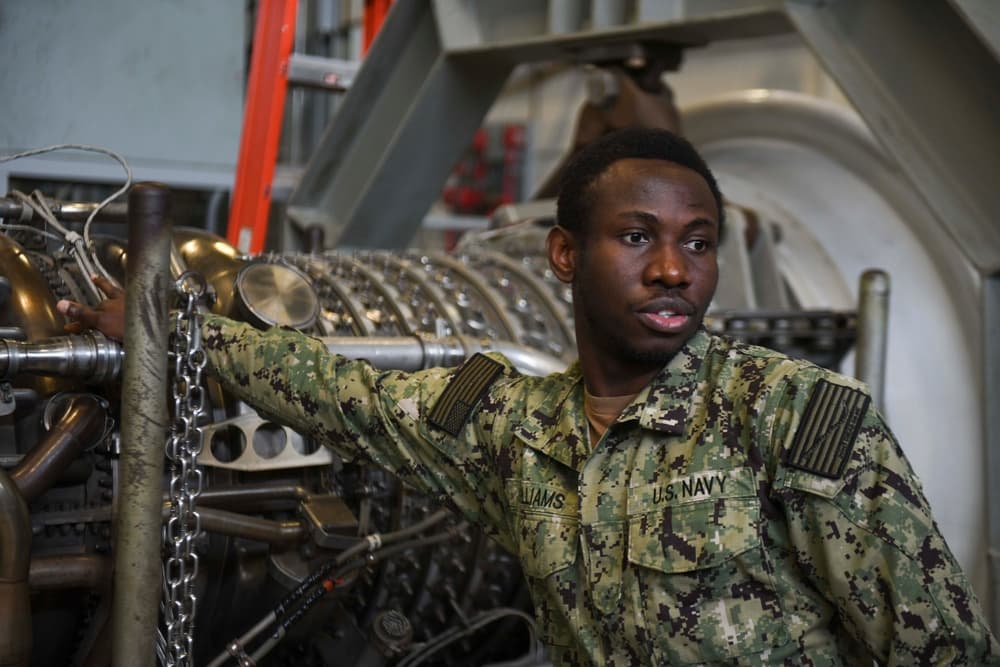
GSMGas Turbine Systems Technician Mechanical(GSM Navy Rating)
Maintains mechanical components of gas turbine engines on surface ships.
Overall
Quick Stats
- ✓Normal color perception
- ✓No speech impediment
Security Clearance
No Clearance — Open to Permanent Residents
This rate does not require a security clearance and is open to lawful permanent residents (green card holders) as well as U.S. citizens.
ASVAB Requirements
AFQT Minimum
31
Line-score options — meet any one
- VE+AR+MK+AS≥200
- VE+AR+MK+AO≥205
Who This Is Best For
Best for mechanically inclined individuals who enjoy hands-on work on high-performance engines and want transferable skills for power generation, marine engineering, and industrial maintenance careers. If you like understanding how complex propulsion machinery works together, this rate provides deep mechanical expertise.
+Pros
- ✓Strong opportunity advancement outlook
- ✓Strong civilian career transition
–Cons
- ✗Significant sea duty
Real Opinions
+Positive
“Engineering rates get a bad rap but the job security and trade skills are legit. I went straight into a union job.”
“I absolutely love my job in the military. I enjoy troubleshooting and fixing the issue with no complaints. The experience is great for learning about gas turbine engines, oil and fuel systems, and pneumatic air systems. Advancement for GSM is currently the best compared to other engineering rates.”
–Negative & Mixed
“Underway life in engineering is hot, loud, and exhausting. You will stand watch in some miserable conditions.”
“In addition to the long hours and days away from home, the pay is not always equivalent to the civilian job. I personally don't think the ships are managed well. GSMs work VERY hard, get dirty, and get less sleep compared to anyone else on the ship. Engine rooms frequently exceed 100 degrees.”
Page 1 of 3
Share your opinion about GSM
0 charsRecruiter vs Reality
What the recruiter says vs. what it's actually like.
🫡 Recruiter says
“Engineering rates are always in demand and you will learn a valuable trade!”
💀 Reality
Source: MyNavyRates researchThe trade skills are real but underway life in engineering spaces is hot, loud, and physically demanding. Watch rotations can be exhausting, especially on older ships.
🫡 Recruiter says
“GSM skills transfer to civilian mechanical jobs.”
💀 Reality
Source: sailor forumsGSM experience with large turbine engines is valued in power generation and marine industries. The mechanical fundamentals are solid and transferable.
Page 1 of 7
Horror Stories
Real stories people have shared about this rate. Swipe to browse.
“GSM advancement past 2nd class is brutal. The rate is heavily overmanned, which means even sailors with perfect eval scores and strong exam results can sit at E-5 for years waiting for a slot to open up. GSM1 advancement rates have historically hovered in the single digits to low teens percentage-wise, making it one of the more frustrating promotion bottlenecks in the surface fleet. The work itself is punishing — long hours in scorching hot engine rooms maintaining gas turbine propulsion systems, with the constant roar of machinery drowning out everything. You come home smelling like JP-5 and hydraulic fluid, and for all that effort, the Navy tells you there simply are not enough billets at the next paygrade. Sailors who love engineering stick it out, but many get fed up watching their peers in other ratings promote while they remain stuck.”
Story 1 of 3
Share a horror story about GSM
0 charsRelated Reading
Guides on picking a rate, ASVAB, bonuses, promotion, and life after the Navy.
Getting Started
How do you choose the right Navy rate for you?
Choosing a Navy rate means weighing your ASVAB scores, lifestyle preferences, civilian career goals, and willingness to deploy or go to sea. Start by identifying which ratings you qualify for, then narrow the list by what matters most to you.
Getting Started
What is the ASVAB and what scores do you need?
The ASVAB is a multi-aptitude test that determines which Navy ratings you qualify for. Your sub-test scores combine into line scores, and each rating has minimum line-score requirements. Higher scores open more options.
Career & Pay
Which Navy rates have the biggest enlistment bonuses in 2026?
Active Component (Active Duty) only. Per the CNRC GENADMIN dated 24 July 2026, the biggest source-rate bonus is $40,000 — Nuclear Field on FY26 ship dates ($75,000 EB cap). Special Warfare Boat Operator (SB) follows at $35,000, then EOD and SEAL (SO) at $30,000, and Aviation Rescue Swimmer (AIRR) and Cryptologic Technician Maintenance (CTM) at $25,000. Special Operations Future Sailors who clear the elevated PST standards add a flat $20,000 EBPST. Most rates cap at $50,000 total EB. The Loan Repayment Program adds up to $65,000 on top, separately. Reserve component (SELRES) bonuses are governed by a different message and are not covered here.