 MR
MRMachinery Repairman(MR Navy Rating)
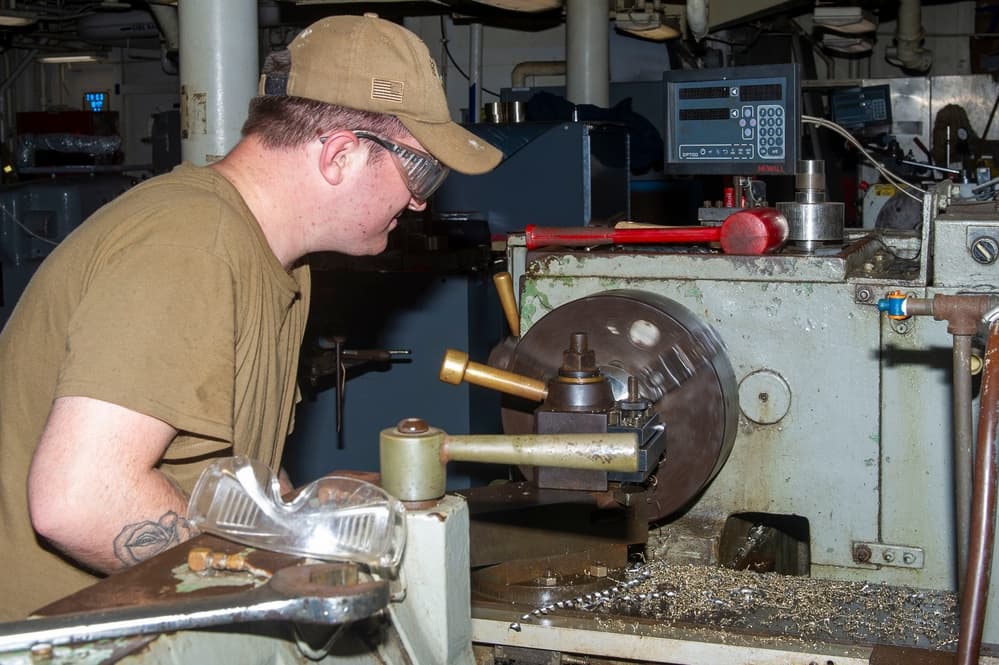
Operates lathes, milling machines, and other precision metalworking equipment.
Overall
Quick Stats
- ✓Vision: Corrects to 20/20
- ✓Normal color perception
Security Clearance
No Clearance — Open to Permanent Residents
This rate does not require a security clearance and is open to lawful permanent residents (green card holders) as well as U.S. citizens.
ASVAB Requirements
Who This Is Best For
Best for precision-minded individuals who enjoy CNC operations, machining, and fabrication from raw materials. If you take satisfaction in creating exact parts when no replacement exists, this rate provides exceptional hands-on machinist training transferable to manufacturing, aerospace, and industrial toolmaking careers.
+Pros
- ✓Strong civilian career transition
–Cons
Real Opinions
+Positive
“The Navy depends on about 770 sailors with this job to make parts that cannot be bought from anywhere else.”
“Senior petty officers and chiefs often remain until retirement, as skilled machinist jobs are valuable both inside and outside the Navy.”
–Negative & Mixed
“Underway life in engineering is hot, loud, and exhausting. You will stand watch in some miserable conditions.”
“The Navy depends on only about 770 Sailors with this job — it is one of the smallest rates in the entire Navy. The small community size limits promotion opportunities compared to larger ratings.”
Page 1 of 3
Share your opinion about MR
0 charsRecruiter vs Reality
What the recruiter says vs. what it's actually like.
🫡 Recruiter says
“Engineering rates are always in demand and you will learn a valuable trade!”
💀 Reality
Source: MyNavyRates researchThe trade skills are real but underway life in engineering spaces is hot, loud, and physically demanding. Watch rotations can be exhausting, especially on older ships.
🫡 Recruiter says
“MR can make anything.”
💀 Reality
Source: sailor forumsMR work is impressive but mostly involves fabricating replacement parts for aging ship equipment. You will not be designing products or doing creative metalwork.
Page 1 of 7
Horror Stories
Real stories people have shared about this rate. Swipe to browse.
“Sharp metal shavings fly in a confined machine shop with poor ventilation. Cutting tools don't stop spinning because the ocean gets rough. They take you young so it won't kill you.”
Story 1 of 4
Share a horror story about MR
0 charsRelated Reading
Guides on picking a rate, ASVAB, bonuses, promotion, and life after the Navy.
Getting Started
How do you choose the right Navy rate for you?
Choosing a Navy rate means weighing your ASVAB scores, lifestyle preferences, civilian career goals, and willingness to deploy or go to sea. Start by identifying which ratings you qualify for, then narrow the list by what matters most to you.
Getting Started
What is the ASVAB and what scores do you need?
The ASVAB is a multi-aptitude test that determines which Navy ratings you qualify for. Your sub-test scores combine into line scores, and each rating has minimum line-score requirements. Higher scores open more options.
Career & Pay
Which Navy rates have the biggest enlistment bonuses in 2026?
Active Component (Active Duty) only. Per the CNRC GENADMIN dated 24 July 2026, the biggest source-rate bonus is $40,000 — Nuclear Field on FY26 ship dates ($75,000 EB cap). Special Warfare Boat Operator (SB) follows at $35,000, then EOD and SEAL (SO) at $30,000, and Aviation Rescue Swimmer (AIRR) and Cryptologic Technician Maintenance (CTM) at $25,000. Special Operations Future Sailors who clear the elevated PST standards add a flat $20,000 EBPST. Most rates cap at $50,000 total EB. The Loan Repayment Program adds up to $65,000 on top, separately. Reserve component (SELRES) bonuses are governed by a different message and are not covered here.