myNavyRates.rg
Home/Compare All Rates/ABF
Donate
Compare All RatesBest ListsQuizPayBonusesASVAB CalculatorAdvancement Name SearchDuty StationsFamily ImpactFree DegreeRecruitersBe an OfficerArticlesFAQs
myNavyRates.rg
Donate

Explore

  • All Rates
  • Side-by-Side
  • Best Lists
  • Articles
  • FAQs

Tools

  • Take the Quiz
  • Anti-Match Quiz
  • ASVAB Calculator
  • Pay
  • Pay Value
  • Bonuses
  • Advancement

Life in the Navy

  • Duty Stations
  • Family Impact
  • Free Degree
  • Be an Officer
  • Recruiters

About

  • About
  • Contact
  • Changelog
  • Donate
  • Privacy
  • Disclaimer
  • Sitemap

Not affiliated with the U.S. Navy or Department of Defense.·© 2026 myNavyRates.org. All rights reserved.

HomeCompare RatesQuizBonusesASVAB CalculatorMore
Home/Rates/ABF
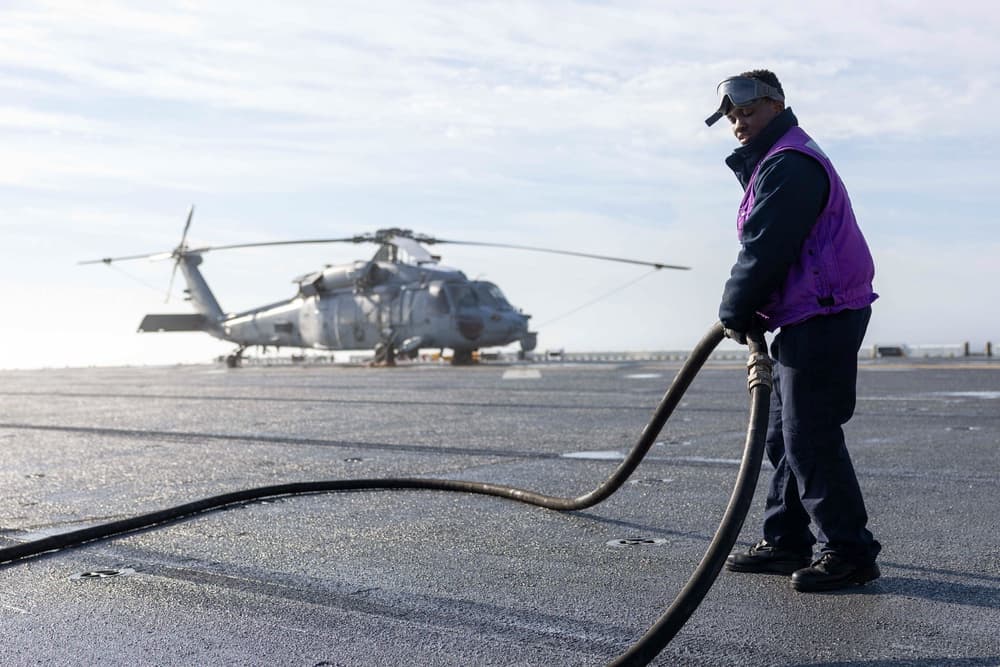
Aviation Boatswain's Mate Fuels sailor
Aviation Boatswain's Mate Fuels rating badgeABF

Aviation Boatswain's Mate Fuels(ABF Navy Rating)

Manages aviation fuel systems and handles fuel for aircraft aboard carriers.

Overall

4.5/10
Burnout5.6
Lifestyle5.0
Civilian ROI2.9
Happiness3.2
Manning %5.6
$$$ Pay5.0

Quick Stats

Enlistment BonusNo active bonus
Civilian Sector Transferability$35k–$55k
Advancement OutlookAverage
Manning %92%
Initial Contract2 yr active /
Medical Requirements
  • ✓Vision: Corrects to 20/20 (uncorrected ≤ 20/100)
  • ✓Normal color perception
  • ✓Normal hearing

Security Clearance

Secret~$3K–$15K civilian sector value

Requires a National Agency Check with Local Agency Check and Credit Check (NACLC). Processing typically takes 1–3 months and is initiated early in your training pipeline.

ASVAB Requirements

AFQT Minimum

31

Line-score options — meet any one

Who This Is Best For

Best for safety-conscious, methodical individuals who take pride in essential behind-the-scenes work. If you prefer a structured routine over high-visibility action and are comfortable handling hazardous materials, this rate offers steady work with transferable skills in the petroleum and energy sector. Ideal for someone who doesn't need the spotlight but wants a meaningful contribution to every mission that launches.

+Pros

  • ✓Strong civilian career transition

–Cons

  • ✗Significant sea duty

Real Opinions

+Positive

✓

“I would recommend ABF to anyone considering it. The training is solid and the community takes care of its own.”

r/navy|
✓

“ABF gave me a strong work ethic and the ability to perform under extreme pressure. Handling millions of gallons of jet fuel on a carrier taught me discipline and attention to detail. The safety training alone is worth more than any classroom — one mistake with JP-5 and people die.”

Indeed|

–Negative & Mixed

⚬

“ABF gets a bad reputation but someone has to fuel the jets. The work is straightforward and the community is tight.”

Indeed|
✗

“You are constantly exposed to JP-5 fumes. The long-term health effects are a real concern.”

Indeed|

Page 1 of 3

Share your opinion about ABF

0 chars
Select one:

Recruiter vs Reality

What the recruiter says vs. what it's actually like.

🫡 Recruiter says

“The ABF rate offers great training and career advancement opportunities!”

💀 Reality

Source: MyNavyRates research

Training and advancement are available but vary by command and manning. Ask specific questions about sea/shore rotation, typical duty stations, and advancement rates for ABF.

🫡 Recruiter says

“ABF has great camaraderie on the flight deck.”

💀 Reality

Source: sailor forums

True, but ABF is one of the more physically demanding aviation rates. You are working in all weather conditions on an exposed flight deck, handling heavy fuel hoses.

Page 1 of 7

😱

Horror Stories

Real stories people have shared about this rate. Swipe to browse.

💀

“USS Boxer accidentally contaminated the ship's entire fresh water supply with diesel fuel. 3,000 sailors and Marines drank, bathed, and cooked with contaminated water for weeks. Multiple crew developed rare cancers afterward.”

Source: military.com|

Story 1 of 5

Share a horror story about ABF

0 chars

Related Reading

Guides on picking a rate, ASVAB, bonuses, promotion, and life after the Navy.

Getting Started

How do you choose the right Navy rate for you?

Choosing a Navy rate means weighing your ASVAB scores, lifestyle preferences, civilian career goals, and willingness to deploy or go to sea. Start by identifying which ratings you qualify for, then narrow the list by what matters most to you.

Getting Started

What is the ASVAB and what scores do you need?

The ASVAB is a multi-aptitude test that determines which Navy ratings you qualify for. Your sub-test scores combine into line scores, and each rating has minimum line-score requirements. Higher scores open more options.

Career & Pay

Which Navy rates have the biggest enlistment bonuses in 2026?

Active Component (Active Duty) only. Per the CNRC GENADMIN dated 24 July 2026, the biggest source-rate bonus is $40,000 — Nuclear Field on FY26 ship dates ($75,000 EB cap). Special Warfare Boat Operator (SB) follows at $35,000, then EOD and SEAL (SO) at $30,000, and Aviation Rescue Swimmer (AIRR) and Cryptologic Technician Maintenance (CTM) at $25,000. Special Operations Future Sailors who clear the elevated PST standards add a flat $20,000 EBPST. Most rates cap at $50,000 total EB. The Loan Repayment Program adds up to $65,000 on top, separately. Reserve component (SELRES) bonuses are governed by a different message and are not covered here.

Real Opinions

+Positive

✓

“I would recommend ABF to anyone considering it. The training is solid and the community takes care of its own.”

r/navy|
✓

“ABF gave me a strong work ethic and the ability to perform under extreme pressure. Handling millions of gallons of jet fuel on a carrier taught me discipline and attention to detail. The safety training alone is worth more than any classroom — one mistake with JP-5 and people die.”

Indeed|

–Negative & Mixed

⚬

“ABF gets a bad reputation but someone has to fuel the jets. The work is straightforward and the community is tight.”

Indeed|
✗

“You are constantly exposed to JP-5 fumes. The long-term health effects are a real concern.”

Indeed|

Page 1 of 3

Share your opinion about ABF

0 chars
Select one:

Recruiter vs Reality

What the recruiter says vs. what it's actually like.

🫡 Recruiter says

“The ABF rate offers great training and career advancement opportunities!”

💀 Reality

Source: MyNavyRates research

Training and advancement are available but vary by command and manning. Ask specific questions about sea/shore rotation, typical duty stations, and advancement rates for ABF.

🫡 Recruiter says

“ABF has great camaraderie on the flight deck.”

💀 Reality

Source: sailor forums

True, but ABF is one of the more physically demanding aviation rates. You are working in all weather conditions on an exposed flight deck, handling heavy fuel hoses.

Page 1 of 7

😱

Horror Stories

Real stories people have shared about this rate. Swipe to browse.

💀

“USS Boxer accidentally contaminated the ship's entire fresh water supply with diesel fuel. 3,000 sailors and Marines drank, bathed, and cooked with contaminated water for weeks. Multiple crew developed rare cancers afterward.”

Source: military.com|

Story 1 of 5

Share a horror story about ABF

0 chars
  • VE+AR+MK+AS≥161
Calculate your score →

Medical Requirements — detail

Must have full field of vision. Must have normal depth perception.

Training Pipeline — Total ~14 weeks (3 months)

8w
6w
Boot Camp— 8 weeks
RTC Great Lakes, IL
Basic military training for all recruits
A-School— 6 weeks
NAS Pensacola, FL
5.9% washoutDifficulty: 1.9/10
Technical training for rating qualification
Fleet Assignment— 0 weeks
First duty station
Report to operational command

Calculate Your End Training Date and Holidays and Events You Will Miss During Training

Ship dates are approximate and based on the weekly RTC Great Lakes schedule. Confirm your exact date with your recruiter. Source: bootcamp.navy.mil

Career Progression Milestones

Estimated timeline based on current advancement rates. Actual timing varies by individual performance and Navy needs.

3 mo
1 mo
1yr 5mo
6 mo
1yr 6mo
Training Complete— 3 mo
Pipeline finished (~3 mo) — NAS Pensacola, FL
First Duty Station— 4 mo
Likely sea duty assignment
NEC Specialization Options— 1yr 9mo
6 specializations available
D14A736B749A

Advancement Outlook

E-2 to E-4 Advancement Outlook

Time to E-4: 30 months total

  • E-1 → E-2: 9 months at E-1. Automatic
  • E-2 → E-3: 9 months at E-2. Automatic
  • E-3 → E-4: 12 months at E-3. Automatic

E-4 is automatic — competitive advancement starts at E-5

How to advance faster to E-4

Your recruiter can process you in at E-2 or E-3 on day one if you qualify. Every rung skipped shortens the path to E-4 by months. Official transcripts / certificates required at enlistment.

  • E-2 →Easy
    2 years of JROTC completed. Easiest common path if your high school offers JROTC.
  • E-2 →Moderate
    24+ semester hours/ 36+ quarter hours of college credit (below the associate's threshold). Roughly one full year of college.
  • E-2 →Moderate
    Civil Air Patrol Billy Mitchell Award. Achievable with consistent cadet participation, but requires testing and leadership time.
  • E-2 →Moderate
    Sea Cadet Corps — reaching the Sea Cadet E-2 rate (join by age 17).
  • E-2 to E-3 →Moderate
    Boot camp leadership roles — roles don't auto-pin rank. Advancement comes from earning Honor Recruit or Hall of Fame at graduation (one award only, not stacked).
    • Honor Recruit up to E-2 — effectively the #1 ranked recruit in your division (~60-80 recruits), one Sailor per division per cycle. Selection is based on cumulative performance across all three academic exams, Physical Readiness Test (PRT) scores, uniform and personnel inspections, military bearing, and peer/Recruit Division Commander (RDC) evaluations. Roles that typically compete at this level:
      • Assistant LPO (ALPO) — deputy to the LPO.
      • Master-at-Arms (MAA) — barracks cleanliness, standards, and discipline.
      • Yeoman (YN) — division admin, paperwork, and tracking.
      • Educational Petty Officer (EPO) — study groups, test prep, and academic remediation.
      • Religious Petty Officer (RPO) — coordinates chapel and religious services.
      • Athletic Petty Officer (APO) — leads PT and fitness assessments.
      • Mail Petty Officer — handles mail distribution and tracking.
      • Section Leaders — squad-level leaders below the division-wide roles.
    • Hall of Fame up to E-3 — the most elite recognition at Recruit Training Command (RTC), awarded Navy-wide rather than per division. Requires exceptional performance in every training metric: top-tier scores on all three academic exams (typically 90%+), "Outstanding" on the final Physical Readiness Test (PRT), near-perfect uniform and personnel inspections, held a division leadership role with strong performance, and zero remediation, infractions, or negative marks across the full training cycle. Senior leadership roles positioned to compete:
  • E-3 →Moderate
    3 years of JROTC completed (any service branch). Straightforward if your high school has the program — three school years of enrollment.
  • E-3 →Hard
    Eagle Scout (BSA) or Gold Award (GSUSA) — the highest youth scouting awards. Typically takes years of participation and a capstone service project.
  • E-3 →Hard
    Associate's degree (or 48+ semester hours / 72+ quarter hours of college credit, 100-level or higher from an accredited institution). Two years of full-time college.
  • E-3 →Hard
    Civil Air Patrol Earhart Award. Uncommon — only a small fraction of CAP cadets reach this level.
  • E-3 →Hard
    Sea Cadet Corps — reaching the Sea Cadet E-3 rate (join by age 16).

Ceiling is E-3 at accession — stacking qualifications doesn't push you to E-4 out of the gate.

Ways to accelerate E-4 after you're in

  • Very HardMeritorious Advancement Program (MAP) — Command-nominated promotion that skips the exam entirely. Each command gets a small seasonal quota of MAP slots and hands them to the top performers based on evaluation ranking. Fastest path on paper, but you're competing directly with every other sailor at your command.

Rules can change — verify current criteria with your recruiter and in the latest Navy Recruiting Manual (COMNAVCRUITCOM) before signing any paperwork that assumes a specific entry paygrade.

E-5 and E-6 Advancement Outlook

Average★☆☆★

1 of 4 factors working in your favor · 1 working against you

  • ▼

    Manning

    E5 88%E6 96%
    E5 is balanced while E6 is overmanned. Your advancement outlook depends on which paygrade you're promoting into next.

    Source: N12 Community Health Indicator brief (FY26)

  • ●

    Enlistment bonus

    No

    No active enlistment bonus for this rate. Most ratings do not offer one in any given fiscal year, so this is a neutral signal on its own.
  • ●

    Overall Selective Reenlistment Bonus (SRB) Outlook

    Competitive SRB added/increased · SRB reduced/eliminated
    This rating is not paying a Selective Reenlistment Bonus right now. No retention-pressure signal. Data pulled from the quarterly SRB NAVADMIN.

Bonuses — Click here to see your military pay

How to qualify & get paid

  1. Sign a contract for this rate at MEPS with the bonus(es) listed on your NAVCRUIT 1133/52 Enlistment Guarantee — eligibility is locked at signing.
  2. Ship to Recruit Training Command (RTC) Great Lakes inside the authorized window — EBSHP and EBPST are earned and paid at RTC graduation and cannot be recouped after.
  3. Complete A-school (and any required follow-on C-school or qualifying course) for your rating — EBSR is earned and paid at school graduation, except for the Special-Operations pipelines, which pay later (AIRR after FRS + first duty station; SO after SQT; SB after SWCC Charlie phase; EOD/ND after their respective A-schools).
  4. LRP is paid annually upon submission of a DD 2475; ~25% is withheld for federal taxes, and a W-2 is issued. LRP must be on your contract at accession — it cannot be added later via reclassification.

Important details & disqualifiers

  • •All bonuses on this page are Active Component (Active Duty) only. Reservists (SELRES) follow a separate CNRF incentive message — ask your recruiter.
  • •Future Sailors with Tier 3 education credentials (HiSET / GED / alternative) are NOT authorized any EB.
  • •AFQT score must be ≥ 31 for EBSHP and ≥ 50 for LRP.
  • •EBSR is the only EB type that can be partially recouped if you separate before completing the obligated service. EBSHP / EBPST cannot be recouped after RTC.
  • •Bonus payments are subject to federal income tax withholding.
  • •EB-for-High-School (EBHS) is currently NOT authorized in the July 2026 GENADMIN — distinct from earlier cycles when it was offered.
  • •Funding: NDAA 2026 authorizes contracts through 31 December 2026; appropriations cover obligations through 30 September 2026; max-EB authority extends through 10 January 2027 — all subject to congressional reauthorization of 37 USC § 331.
  • •This rate requires a security clearance — failure to obtain clearance may affect bonus eligibility (and several special-operations footnotes explicitly require an earned NEC + clearance before payment).

No initial enlistment bonus for this rate per the current CNRC GENADMIN. Career Sailors may still qualify for a Selective Reenlistment Bonus (SRB) — see the Reenlistment section below.

You May Qualify for a Navy Enlisted Classification (NEC)

Specialties within this rate you can select, some with additional compensation. Each NEC has its own training, bonus potential, and career path.

0000Any NEC or no NEC (all qualifying Sailors in this rating)

Selective Reenlistment Bonus (SRB)

—

First Reenlistment (17 mo to 6 yrs Active Duty)

Not eligible

🔴

Second Reenlistment (6 to 10 yrs Active Duty)

$30,000

Max

Being Eliminated · effective 2025-12-18

🔴

Third Reenlistment (10 to 14 yrs Active Duty)

$30,000

Max

Being Eliminated · effective 2025-12-18

D14AAviation Fuels Maintenance Technician

Performs organization level maintenance on automotive gasoline systems, aviation fuels systems afloat and ashore, and catapult lube oil distribution and stowage systems. Operates electric pumps, electric valve, tank level indicating and control systems, centrifugal purifiers and manifolds for fuel, oil, CO2, and inert gas systems. Repairs and adjusts valves, pumps, filters, and meters.

Potential Civilian Post-Navy Outcomes

Fuel Systems Technician

Transferability: 6/10

$35k–$55k

Aviation Fueling Supervisor

Transferability: 6/10

$40k–$60k

Post-Navy Salary Trajectory

Estimated civilian salary growth after separating from the Navy, based on industry data for this rating's skill set.

Year 1

$35K

Year 5

$45K

Year 10

$55K

10-year growth: +57%

Retention & Burnout

First-Term Retention

33%

choose to reenlist

Burnout Index

5.6/10

Moderate

Watch Intensity

5

Hours/Day

9

Deploy Tempo

8

Manning Strain

2

Low Morale Risk

7

Attrition Signal

7

What this means: The Burnout Index combines watch intensity (25%), daily hours (20%), deployment tempo (15%), manning strain (15%), morale (15%), and attrition (10%) into a single risk score.

Lifestyle5/10

Ship vs. Shore Split

70% / 30%

Sea Duty Tempo

High — 8/10

Physical Demand

high — outdoor

Sea Duty Tempo measures how much of a career is spent in deployable billets — ships, submarines, deploying squadrons, and expeditionary units — and how often those units leave homeport. It is separate from physical demand: an administrative job aboard a deployed unit still deploys, and a hands-on maintenance job at a shore command does not.

Watch Standing

Flight schedule dependent, rotating duty days

Watch standing is a 24-hour duty rotation where sailors take turns manning critical positions aboard the ship or at their command. The rotation determines how frequently you stand watch and how much rest time you get between shifts.

Watch qualifications vary by command and platform. Expect to qualify within 90 days of reporting.

OPNAVINST 3120.32DUSNI ProceedingsNavy Watch Standing Manual

Life on Watch — Sea Stories

“I was on the fuel farm during a hot refueling — aircraft engines running, pilots in the cockpit — when my fuel hose gauge showed a pressure spike that shouldn't have been there. I immediately called a fuel stop and disconnected. Turns out a check valve in the fuel station had failed and was allowing backflow pressure. If I hadn't caught it, the overpressure could have ruptured the fuel hose while connected to an aircraft with running engines. My Chief said that kind of situational awareness is the difference between a normal fueling evolution and a flight deck catastrophe. When you handle JP-5, there are no small mistakes.”

Veteran account (composite)

Story 1 of 4

Common Duty Stations

Naval Station NorfolkSea
Family Friendly

6.9/10

Schools + spouse jobs

Base Housing Wait

10 months

Avg waitlist for on-base

Cost of Living

95

100 = national avg

Naval Base San DiegoSea
Family Friendly

7.9/10

Schools + spouse jobs

Base Housing Wait

14 months

Avg waitlist for on-base

Cost of Living

135

100 = national avg

Naval Station JacksonvilleShore
🎓

Step-by-Step Strategy Guide to Getting an Associate's Degree After Boot Camp — For Free

Most sailors don't know they already have 9 or more general education college credits just from graduating boot camp.

Based on your rate, you may have more.

You can earn an associate's degree for free in 12-30 months without spending a dime.

Strategy Guide & Boot Camp College Credit Calculator →
Not the rate for you? See other ratings side by side →

Talk to a Sailor

Community Poll

If you could go back, would you pick ABF again?

Career & Pay

How does promotion work in the Navy?

Navy advancement depends on exam scores, evaluations, time in rate, and available quotas. Some ratings promote over 50% of eligible sailors while others promote less than 5%. Your rate choice directly affects how fast you can advance.

Career & Pay

Which Navy jobs set you up best for a civilian career?

Information warfare ratings (IT, CTN, IS) and medical ratings (HM) offer the strongest civilian career pipelines. Security clearances, technical certifications, and hands-on experience make these sailors highly competitive in the private sector.

Browse all articles →

Life on Watch — Sea Stories

“I was on the fuel farm during a hot refueling — aircraft engines running, pilots in the cockpit — when my fuel hose gauge showed a pressure spike that shouldn't have been there. I immediately called a fuel stop and disconnected. Turns out a check valve in the fuel station had failed and was allowing backflow pressure. If I hadn't caught it, the overpressure could have ruptured the fuel hose while connected to an aircraft with running engines. My Chief said that kind of situational awareness is the difference between a normal fueling evolution and a flight deck catastrophe. When you handle JP-5, there are no small mistakes.”

Veteran account (composite)

Story 1 of 4

761A
+ more
C-School / Advanced Training— 2yr 3mo
1 follow-on school available
Shore Duty Rotation— 3yr 9mo
First shore rotation opportunity
  • Leading Petty Officer (LPO) — runs day-to-day ops inside the division.
  • Assistant RCPO (ARCPO) — backs up the RCPO and steps in when needed.
  • Recruit Chief Petty Officer (RCPO) — senior recruit in the division, overall accountability to the RDCs. Highest visibility for meritorious advancement.
+0
−2
No current SRB
  • ▲

    Billet-Based Advancement eligibility

    On Billet-Based Advancement list (E-5 / E-6)

    Active-duty E-5 & E-6 now use Billet-Based Advancement (BBA)

    Advancement depends on authorized billets at the commands you're eligible to fill — not a fleet-wide cycle quota. You can use Command Advance to Position (CA2P) or Advance to Position (A2P) to sign for vacant billets and promote. MyNavy Assignment is your primary tool. Read the full Billet-Based Advancement guide.

    Project Compass— PERS-4's new billet-recommendation engine inside MyNavy Assignment — emails E-4 through E-9 Sailors up to 14 personalized billet matches before each cycle's application phase. It scores billets against your MNA preferences and qualifications, so keeping your MNA preferences current directly improves the quality of recommendations. How Project Compass works.

  • Sources: Manning NAVADMIN · SRB NAVADMIN · Billet-Based Advancement Handbook (NAVADMIN 255/24, updated via NAVADMIN 112/25). How to interpret these factors →

    736BNAMTS Pump Repair Technician

    Performs Navy Afloat Maintenance Training Strategy (NAMTS) organizational and intermediate-level maintenance procedures, inspecting and repairing marine main propulsion and auxiliary pumps and associated equipment in support of Fleet-directed requirements.

    749AAir Transportation Specialist

    Performs duties associated with the movement of passengers, air cargo packing, operations, documentation and selection. Performs aircraft load planning and the safe operation of material handling equipment.

    761ANAMTS Hydraulics Repair Technician

    Performs Navy Afloat Maintenance Training Strategy (NAMTS) organizational and intermediate-level maintenance procedures on hydraulic systems and components of propulsion machinery, auxiliary equipment, and outside machinery in support of Fleet-directed requirements.

    Requirements

    • Award of this NEC code is based on documented completion of tasks for this skill; demonstration of advanced-level proficiency during hands-on training; and production work specified in the current JQR located at https://navsea.navy.deps.mil/field/CNRMC/NAMTS/jqrs.aspx. Training is led by journeyman-level craftsmen and supplemented by appropriate self-paced instruction consistent with Department of Labor journeyman certification.
    786BShore Base Airport & Aircraft Firefighter

    Certified in accordance with National Fire Protection Agency (NFPA) Standards as an Airport Firefighter including Firefighter I & II. Performs duties as a rescue, firefighting, and salvage team member aboard Naval Air Stations, Facilities, Outlying Fields and other Naval Activities ashore. Performs structural firefighting in support of base structural firefighting companies.

    Requirements

    • NEC code is awardable to ABE, ABF, ABH, and DC Source Ratings for Active Duty Component personnel and is awardable to ALL Source Ratings for Reserve Component personnel. The primary non-ABH personnel who are assigned this NEC code will be associated with the Commander, Navy Installations Command, Fire and Emergency Services program.
    788AAcquisition Specialist

    Perform critical functions within acquisition type activities (i.e., Integrated Logistics Support (ILS), Naval Air Training Management Support Activity (NATMSACT) as defined in DoD Directive 5000.1 and DoD Instruction 5000.2.

    Requirements

    • NEC code awarded after one year of acquisition billet service, and completion of the currently published Defense Acquisition University (DAU) courses for Defense Acquisition Workforce Improvement Act (DAWIA) foundational certification in Lifecycle Logistics (LCL) and/or Test & Evaluation (T&E).
    • DAWIA training courses are obtained and funded for Navy personnel through the Defense Acquisition Talent Management (DATM) Office via the DON Acquisition Training Registrar, Naval Acquisition Career Management Center, 5450 Carlisle Pike, P.O. Box 2033, Mechanicsburg, PA 17055 using quotas that are assigned to the requesting command. Individuals must be currently in or ordered to an identified Acquisition billet.
    Family Friendly

    6.8/10

    Schools + spouse jobs

    Base Housing Wait

    8 months

    Avg waitlist for on-base

    Cost of Living

    92

    100 = national avg

    View all stations →

    Real questions from people considering Aviation Boatswain's Mate Fuels, answered by current and former sailors.

    No questions yet for Aviation Boatswain's Mate Fuels.

    Be the first to ask!

    0/500

    ✈️ Related Navy Ratings in Aviation

    Other aviation ratings sailors often compare against ABF Aviation Boatswain's Mate Fuels.

    ABEAviation Boatswain's Mate - Launch & RecoveryABHAviation Boatswain's Mate HandlingACAir Traffic ControllerADAviation Machinist's MateAEAviation Electrician's MateAGAerographer's MateAMAviation Structural MechanicAMEAviation Structural Mechanic – EquipmentAOAviation OrdnancemanASAviation Support Equipment TechnicianATAviation Electronics TechnicianAWNaval AircrewmanAWFAircrewman HelicopterAWOAircrewman OperatorAWRAircrewman Tactical HelicopterAWSAircrewman HelicopterAWVAircrewman AvionicsAZAviation Maintenance AdministrationmanPRAircrew Survival Equipmentman
    Compare ABF side-by-side with these ratings→