 AD
ADAviation Machinist's Mate(AD Navy Rating)
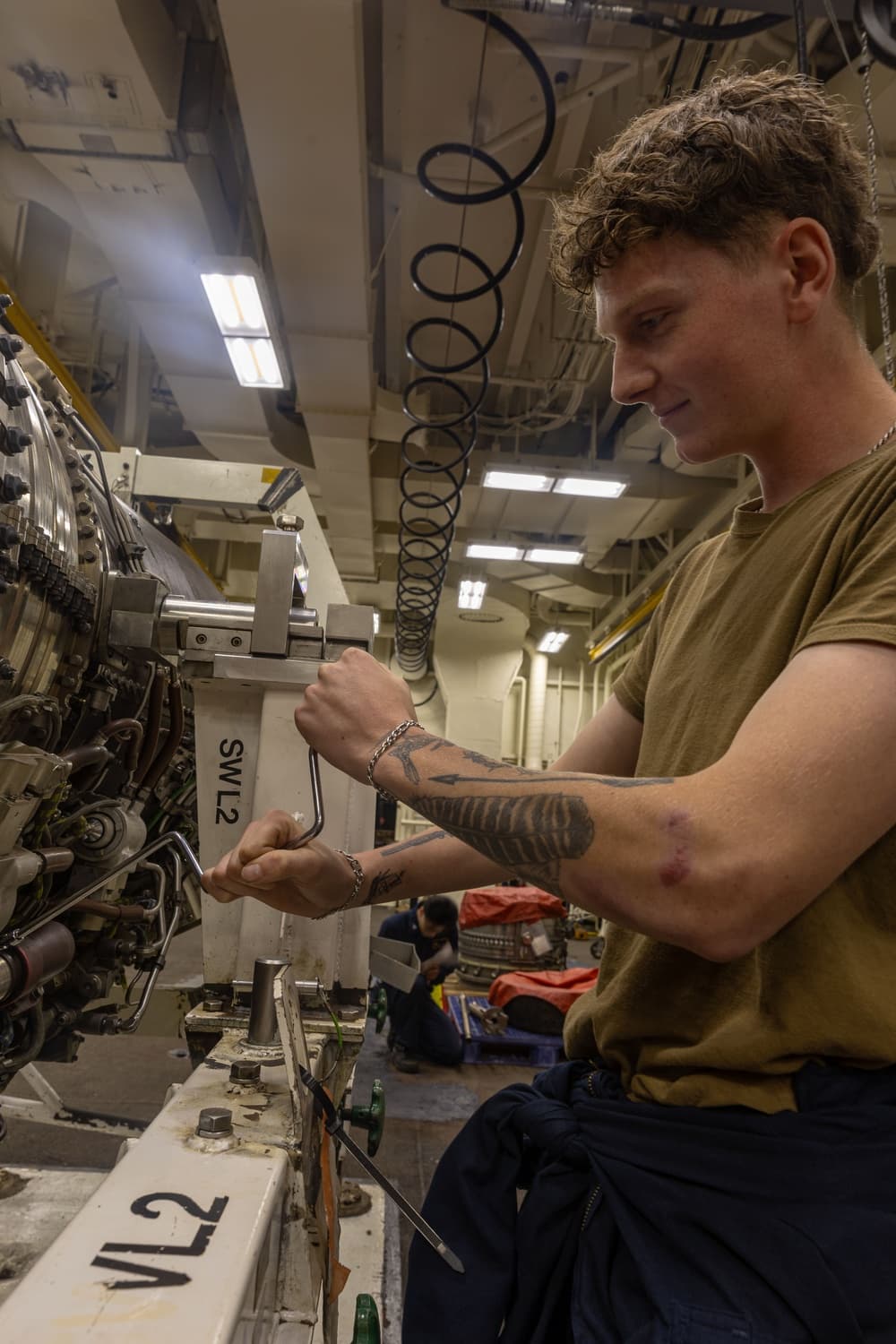
Aviation Machinists Mates maintain and repair aircraft engines, propellers, and related systems. They perform scheduled and unscheduled maintenance on turbine engines, test cells, and power plants.
Overall
Quick Stats
- ✓Vision: Corrects to 20/20
- ✓Normal color perception
- ✓Normal hearing
Security Clearance
No Clearance — Open to Permanent Residents
This rate does not require a security clearance and is open to lawful permanent residents (green card holders) as well as U.S. citizens.
ASVAB Requirements
Line-score options — meet any one
- VE+MK+AS≥158
- VE+MK+EI≥155
Who This Is Best For
Best for hands-on problem solvers who enjoy diagnosing mechanical issues and want credentials that directly transfer to well-paying aerospace careers. If you like taking things apart and putting them back together, this rate builds A&P certification hours that airlines and defense contractors actively recruit for. Steady advancement with tangible, marketable skills.
+Pros
- ✓Strong civilian career transition
–Cons
Real Opinions
+Positive
“I would recommend AD to anyone considering it. The training is solid and the community takes care of its own.”
“Great hands-on experience working on jet engines. The training you get is world class and transfers directly to civilian aviation maintenance jobs.”
–Negative & Mixed
“Like any rate, AD has its downsides. Long hours, time away from family, and Navy bureaucracy are real.”
“Long hours on the flight deck, especially during deployment. 12-on 12-off is the norm at sea and it wears you down fast.”
Page 1 of 3
Share your opinion about AD
0 charsRecruiter vs Reality
What the recruiter says vs. what it's actually like.
🫡 Recruiter says
“The AD rate offers great training and career advancement opportunities!”
💀 Reality
Source: MyNavyRates researchTraining and advancement are available but vary by command and manning. Ask specific questions about sea/shore rotation, typical duty stations, and advancement rates for AD.
🫡 Recruiter says
“AD is great for a career at Boeing or Pratt & Whitney.”
💀 Reality
Source: sailor forumsThe experience is relevant but civilian aviation companies require FAA A&P certification. The Navy will fund this through COOL but you have to apply and study for it yourself.
Page 1 of 7
Horror Stories
Real stories people have shared about this rate. Swipe to browse.
“I was turning up a running F/A-18 on the fantail for an engine trim check, lanyard clipped to the stanchion, cranial tight. My kneeboard came loose. Reflexively, I bent forward to grab it. The intake suction field on an F404 at military power is a twenty-five-foot sphere of death — anything inside gets pulled into the first-stage compressor in milliseconds. My cranial went in first. The lanyard caught me to the stanchion and stopped me with my face two feet from the lip of the intake. My ears bled from the pressure drop. The engine FODded hard on the cranial — blades shattered, foreign-object damage through all seventeen stages — and I watched three million dollars of engine eat itself with me strapped to the stanchion by a nylon lanyard. NAVSAFECOM's ground mishap data shows fifteen to twenty personnel ingestion events per year across Naval Aviation, and roughly one in eight is fatal. I was the lucky seven. I still do not turn my head fast near running aircraft.”
Story 1 of 5
Share a horror story about AD
0 charsRelated Reading
Guides on picking a rate, ASVAB, bonuses, promotion, and life after the Navy.
Getting Started
How do you choose the right Navy rate for you?
Choosing a Navy rate means weighing your ASVAB scores, lifestyle preferences, civilian career goals, and willingness to deploy or go to sea. Start by identifying which ratings you qualify for, then narrow the list by what matters most to you.
Getting Started
What is the ASVAB and what scores do you need?
The ASVAB is a multi-aptitude test that determines which Navy ratings you qualify for. Your sub-test scores combine into line scores, and each rating has minimum line-score requirements. Higher scores open more options.
Career & Pay
Which Navy rates have the biggest enlistment bonuses in 2026?
Active Component (Active Duty) only. Per the CNRC GENADMIN dated 24 July 2026, the biggest source-rate bonus is $40,000 — Nuclear Field on FY26 ship dates ($75,000 EB cap). Special Warfare Boat Operator (SB) follows at $35,000, then EOD and SEAL (SO) at $30,000, and Aviation Rescue Swimmer (AIRR) and Cryptologic Technician Maintenance (CTM) at $25,000. Special Operations Future Sailors who clear the elevated PST standards add a flat $20,000 EBPST. Most rates cap at $50,000 total EB. The Loan Repayment Program adds up to $65,000 on top, separately. Reserve component (SELRES) bonuses are governed by a different message and are not covered here.