 PR
PRAircrew Survival Equipmentman(PR Navy Rating)
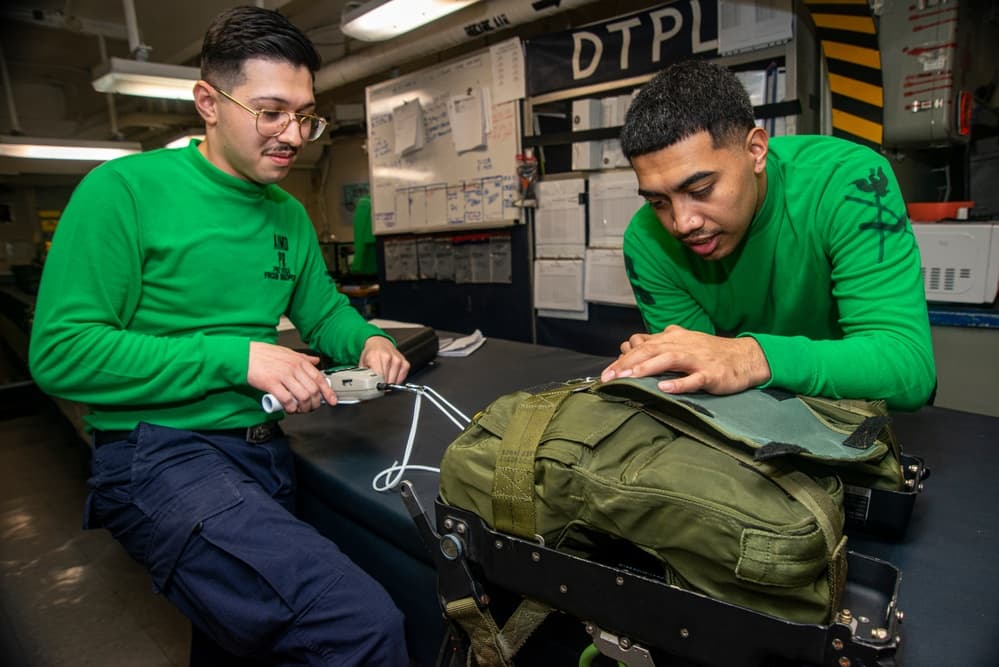
Maintains parachutes, life rafts, and survival equipment for naval aviation.
Overall
Quick Stats
- ✓Vision: Corrects to 20/20
- ✓Normal color perception
Security Clearance
No Clearance — Open to Permanent Residents
This rate does not require a security clearance and is open to lawful permanent residents (green card holders) as well as U.S. citizens.
ASVAB Requirements
Who This Is Best For
Best for meticulous individuals who take safety personally and want to work in a specialized niche where perfection is the only standard. If you find satisfaction in knowing your precise work protects lives, this rate offers strong camaraderie in a small, respected community. Civilian transfer options are narrow but the work is deeply meaningful.
+Pros
- ✓Strong civilian career transition
–Cons
Real Opinions
+Positive
“I would recommend PR to anyone considering it. The training is solid and the community takes care of its own.”
“PR is one of the most chill aviation rates. You maintain life-saving equipment and work mostly in a shop environment with normal hours.”
–Negative & Mixed
“Like any rate, PR has its downsides. Long hours, time away from family, and Navy bureaucracy are real.”
“Advancement is slow because the community is small. You can be stuck at E-4 for a long time.”
Page 1 of 3
Share your opinion about PR
0 charsRecruiter vs Reality
What the recruiter says vs. what it's actually like.
🫡 Recruiter says
“The PR rate offers great training and career advancement opportunities!”
💀 Reality
Source: MyNavyRates researchTraining and advancement are available but vary by command and manning. Ask specific questions about sea/shore rotation, typical duty stations, and advancement rates for PR.
🫡 Recruiter says
“PR is a small, tight-knit aviation rate.”
💀 Reality
Source: sailor forumsTrue, and the small size means limited advancement opportunities and fewer duty station options. Most PR billets are at air stations.
Page 1 of 7
Horror Stories
Real stories people have shared about this rate. Swipe to browse.
“I was topping off a LOX converter in the PR shop — liquid oxygen, minus 297 degrees, stored in a vacuum-jacketed 25-liter dewar. Standard evolution. I had done it a hundred times. A drop of LOX hit a smudge of hydraulic oil on the fill-stand grating. Oil and liquid oxygen in combination are a detonable contact explosive — NAVSAFECOM calls it hypergolic. There was a white flash and a concussion that threw me across the shop. The converter ruptured. Everything oil-soaked in the compartment — rags, bench tops, the oil on my apron — went up simultaneously in an oxygen-rich fire that burns hotter than any normal shop fire. My partner was blinded in his left eye by a piece of flying dewar. I had flash burns across my chest where the fire found the oil on my coveralls. There was nothing to put out — LOX fires consume themselves in seconds. Naval Safety Command's aviation ground mishap summaries document one LOX incident a quarter. Mine is a line item now.”
Story 1 of 5
Share a horror story about PR
0 charsRelated Reading
Guides on picking a rate, ASVAB, bonuses, promotion, and life after the Navy.
Getting Started
How do you choose the right Navy rate for you?
Choosing a Navy rate means weighing your ASVAB scores, lifestyle preferences, civilian career goals, and willingness to deploy or go to sea. Start by identifying which ratings you qualify for, then narrow the list by what matters most to you.
Getting Started
What is the ASVAB and what scores do you need?
The ASVAB is a multi-aptitude test that determines which Navy ratings you qualify for. Your sub-test scores combine into line scores, and each rating has minimum line-score requirements. Higher scores open more options.
Career & Pay
Which Navy rates have the biggest enlistment bonuses in 2026?
Active Component (Active Duty) only. Per the CNRC GENADMIN dated 24 July 2026, the biggest source-rate bonus is $40,000 — Nuclear Field on FY26 ship dates ($75,000 EB cap). Special Warfare Boat Operator (SB) follows at $35,000, then EOD and SEAL (SO) at $30,000, and Aviation Rescue Swimmer (AIRR) and Cryptologic Technician Maintenance (CTM) at $25,000. Special Operations Future Sailors who clear the elevated PST standards add a flat $20,000 EBPST. Most rates cap at $50,000 total EB. The Loan Repayment Program adds up to $65,000 on top, separately. Reserve component (SELRES) bonuses are governed by a different message and are not covered here.