 FT
FTFire Control Technician(FT Navy Rating)
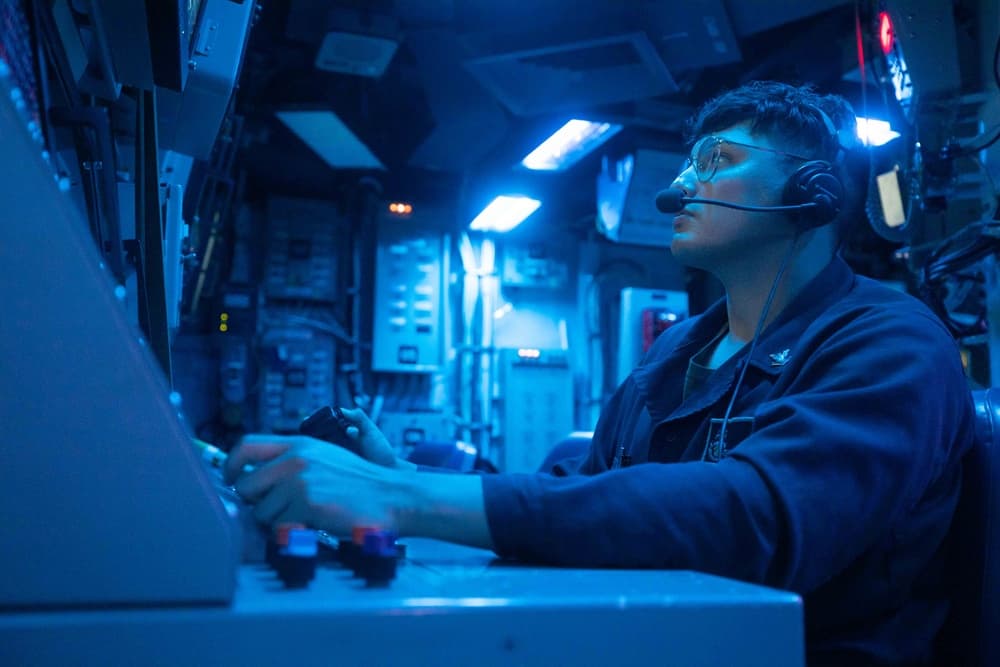
Fire Control Technicians (FTs) are the submarine community''s strategic and tactical weapons specialists. They operate and maintain the weapons and fire control systems that launch the MK-48 ADCAP heavyweight torpedo, the Tomahawk cruise missile, and — aboard SSBN ''boomers'' and SSGNs — the Trident II D5 fleet ballistic missile and strategic weapon system.
FT was split off from the older, combined FT rating when the surface Navy''s fire control work was consolidated into the FC (and later FC/FCA) rating. Today the FT rating exists exclusively in the submarine force. FTs serve on SSN fast-attacks, SSGN guided-missile subs, and SSBN ballistic-missile submarines, with watch stations in the Attack Center and Missile Control Center.
The pipeline is long and technical: Basic Enlisted Submarine School (BESS) in Groton followed by FT ''A'' School at Trident Training Facility Bangor, WA (SSBN/SSGN track) or NSB Kings Bay, GA, with advanced ''C'' schools for specific weapon systems. Top Secret / SCI clearance is standard because FTs routinely handle Single Integrated Operational Plan (SIOP) material on strategic boats.
Overall
Quick Stats
- ✓Normal color perception
- ✓Normal hearing
- ✓No speech impediment
Security Clearance
Top Secret / Sensitive Compartmented Information~$15K–$50K civilian sector value
Requires a Single Scope Background Investigation (SSBI), including interviews with references, financial review, and a possible polygraph. The process typically takes 6–12 months and is initiated during your training pipeline.
ASVAB Requirements
AFQT Minimum
50
Who This Is Best For
Best for analytically sharp candidates who want elite strategic-weapons work on submarines, high-end clearances, and a direct path to defense-industry fire-control and missile engineering careers.
+Pros
- ✓Active enlistment bonus available
- ✓Strong opportunity advancement outlook
- ✓Strong civilian career transition
–Cons
- ✗Long A-school pipeline
- ✗Significant sea duty
Real Opinions
+Positive
“What I love about working at this command is the level of pride everyone takes in their work, and the camaraderie I see every day.”
“Helping to build these torpedoes, and knowing they will be used in the fleet, gives me a tremendous feeling of accomplishment.”
–Negative & Mixed
“Welcome to the Time Machine, young man, where time is just a number in your logbook.”
“Underpaid but you get free training and travel. Food's pretty bad. Commands can be clicky.”
Page 1 of 2
Share your opinion about FT
0 charsRecruiter vs Reality
What the recruiter says vs. what it's actually like.
🫡 Recruiter says
“You'll fire MK-48 torpedoes and Tomahawk missiles — the most advanced weapons in the fleet.”
💀 Reality
Source: https://www.mynavyhr.navy.mil/Portals/55/Career/ECM/Submarine/FT%20career%20path.pdfMost sea time is preventive maintenance, calibration, functional tests, and drills. Actual weapons employment is rare; sailors work long watches in the torpedo room and control during deployments.
🫡 Recruiter says
“Highest ASVAB rating — you'll be surrounded by the smartest sailors on the boat.”
The AR+MK+EI+GS ≥ 222 cut is real, but the pipeline is long: RTC → Basic Enlisted Submarine School → SECF/FT "A" school (Groton). Over a year before you reach a boat, and ~60% of a 20-year career is spent in fleet units.
Page 1 of 4
Horror Stories
Real stories people have shared about this rate. Swipe to browse.
“The qualification pressure on a submarine is unlike anything ashore. Until you have your dolphins you are a burden on the crew and everyone treats you accordingly, and the qualification happens in the time between your watches and your maintenance — which is the time you would otherwise sleep. FTs carry a heavy system qualification on top of the boat qualification.”
Story 1 of 2
Share a horror story about FT
0 charsRelated Reading
Guides on picking a rate, ASVAB, bonuses, promotion, and life after the Navy.
Getting Started
How do you choose the right Navy rate for you?
Choosing a Navy rate means weighing your ASVAB scores, lifestyle preferences, civilian career goals, and willingness to deploy or go to sea. Start by identifying which ratings you qualify for, then narrow the list by what matters most to you.
Getting Started
What is the ASVAB and what scores do you need?
The ASVAB is a multi-aptitude test that determines which Navy ratings you qualify for. Your sub-test scores combine into line scores, and each rating has minimum line-score requirements. Higher scores open more options.
Career & Pay
Which Navy rates have the biggest enlistment bonuses in 2026?
Active Component (Active Duty) only. Per the CNRC GENADMIN dated 24 July 2026, the biggest source-rate bonus is $40,000 — Nuclear Field on FY26 ship dates ($75,000 EB cap). Special Warfare Boat Operator (SB) follows at $35,000, then EOD and SEAL (SO) at $30,000, and Aviation Rescue Swimmer (AIRR) and Cryptologic Technician Maintenance (CTM) at $25,000. Special Operations Future Sailors who clear the elevated PST standards add a flat $20,000 EBPST. Most rates cap at $50,000 total EB. The Loan Repayment Program adds up to $65,000 on top, separately. Reserve component (SELRES) bonuses are governed by a different message and are not covered here.